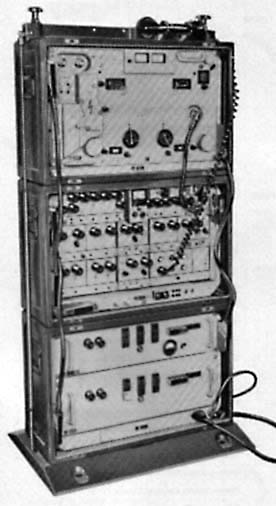
BRUIN SYSTEM
The bulk of the BRUIN information is provided by Roger Greenaway
The BRUIN tactical trunk communications system revolved around Communication
Centres servicing Comheads. The Comcens were interconnected, so it was
possible to communicate from brigade HQ all the way back to Corps HQ, and
even back to the UK.
Brigade Level
Each brigade HQ had two Comheads, namely Main and Step-up. One was
fixed on the ground, while the other was on the move. There were, in the
early 1970s, six manouver brigades in Germany with an independent artillery
brigade, with an additional three infantry brigades when 3 (Airportable)
Division was deployed from the UK for BAOR reinforcement.
Division Level
There were three mechanised divisions in Germany, with, as
already noted, 3 Division in the UK. 3 Division was BRUIN-compatible. Each
division had three Comheads (Main, Step-up and Rear), and maintained 2
Comcens (except for 3 Div, which only had one). The Comcens were designated
alphabetically, being:
1 Division (Verden) : Charlie & Delta
2 Division (Bunde) : Echo & Foxtrot
4 Division (Herford) : Golf & Hotel
3 Division (Bulford) : Whisky
Corps Level
1 (BR) Corps (HQ in Bielefeld) had four Comcens, namely Alpha and
Bravo servicing Corps Main and Step-up HQs (run by 7 Signal Regiment, Herford),
and Uniform (Corps Rear HQ) and Victor (Radio) run by 22 Signal Regiment
(Lippstadt). Comcen Uniform also serviced detachments at WHAs (Weapon Holding
Area) and WSPs (Weapon Supply Point), ie the tactical nuclear capability.
Others
There was a Comcen (part of 21 Signal Regiment) that supported RAF
Germany, and specifically the helicopter and Harrier forces in the field.
Comcen Kilo (16 Signal Regiment, Krefeld) supplied links (cable and static
radio relay) back to the UK. Detachments could be deployed from
division Comcens to flanking foreign brigades, these being Canadian (Lahr),
Dutch (Seedorf) and Belgian (Soest, later Cologne).
Occasionally links were established into USAREUR units (mainly V
Corps) and the Bundeswehr. Detachments, consisting of a radio-relay vehicle
and a terminal equipment vehicle, were deployed as these foreign units
were not BRUIN-compatible. Signal Group (Territorial Army) was not
BRUIN-compatible. The group supplied a line of communication from BAOR
back to the Channel ports and airports, and linked into Comcen Kilo.
BRUIN - EQUIPMENT
The BRUIN system was based on a 6-channel PCM radio-relay network.
Channels 1-4 were routed through an automatic telephone exchange, channel
5 was “manual intercept” and channel 6 multi-channel telegraph.
The Crypto equipment was the BID200 (Dakota), feeding into either
a C50/R236 or C70 radio-relay detachment.
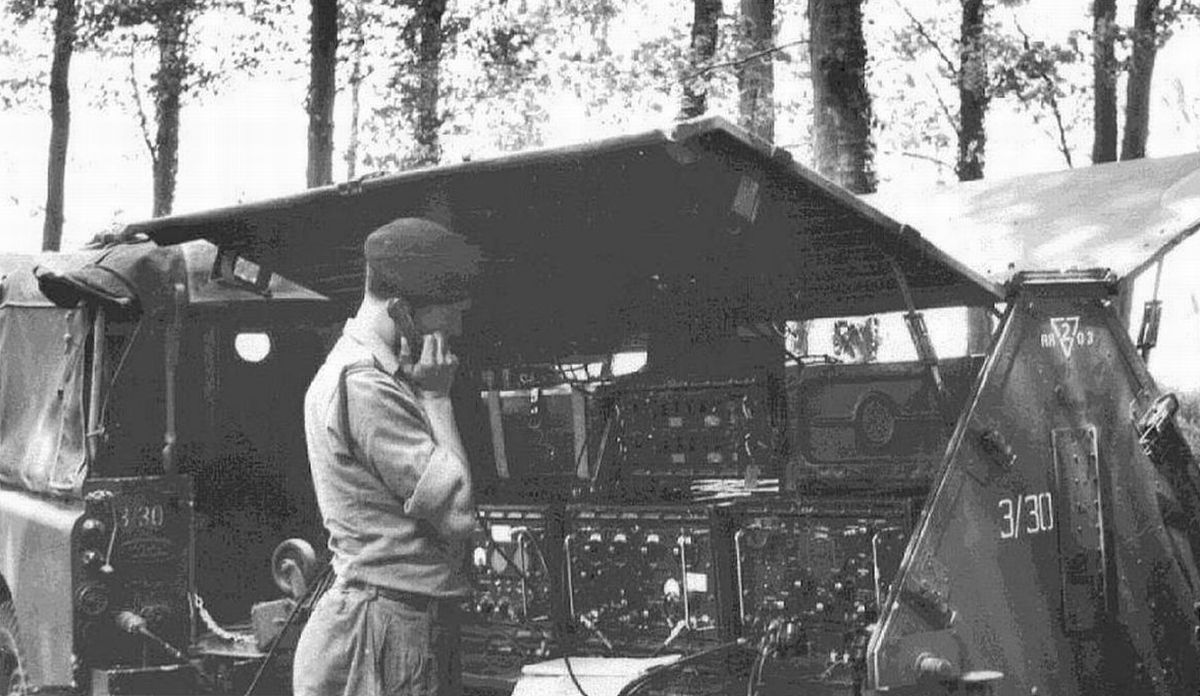
Station, Radio C50/R236
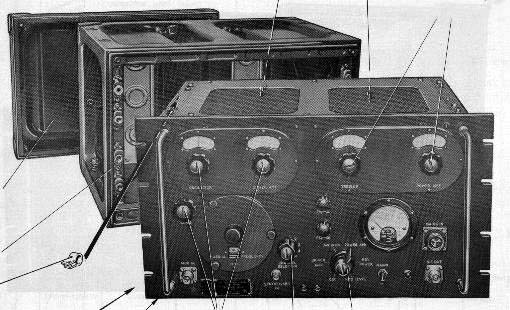
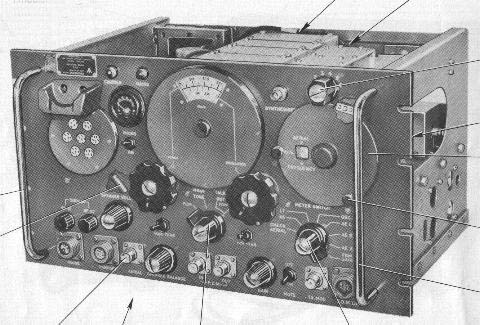
Referred to simply as the C50, it comprised a radio transmitter (C50),
receiver (R236), RF Amplifier (RFA13 with its associated PSU49 & PSU50),
a frequency synthesiser set Plessey PG341, and the line equalizer into
the BID200 system (BID 200/10). Frequency range was 225-400 Mhz with 125
KHz channel separation. Output was 10W ERP with 50W and 200W on medium
power and high power settings when the RFA13 was used. The antenna , known
as a “fishbone”, was a log-periodic (logarithmically-spaced series of transposed
dipoles), fitted as pairs in a single frame in slant polarisation. Beamwidth
was around about 35 degrees with a high front-to-back ratio. The station
could be used dismounted (training purposes and Op. Northern Shot), mounted
in a 1 ton container fitted on a Bedford RL truck, or in a trailer (3 Division
only). They were also fitted into FV439 APCs at brigade level.
Station, Radio C70
Basically this is a Siemens FM12/800, with a different E11 module
from the German version. This set had a frequency range of 560-910
MHz, again with 125KHz channel separation. The antenna was spherical (basically
a spiral embedded into a fibreglass tube). Two were mounted on the mast
and could be connected together, but there had to be greater separation
between transmit and receive frequencies. These were mounted in 1 ton containers
on a Bedford truck chassis, and used at division and corps level.
Deployment:
Brigade signal squadrons had 2 complete sets of vehicles. Each set
consisted of 3x FV439. These versions of the FV432 APC series had 2x 3.½KVA
generators in an armoured bin on top of the vehicle. The three versions
were Auto20, MCVF and radio-relay. The Auto20 had a 20-line Strowger-type
automatic telephone exchange, MCVF the crypto gear (BID200), manual telephone
exchange and teleprinter (Siemens T100R). The radio-relay version, as well
as having a 40ft pneumatic mast fitted, had 2 banks of C50/R236. 3 Division
brigades did not have any trunk capabilities, these were held centrally
at the division signal regiment.
The divisional signal regiments were divided up into squadrons, whereby
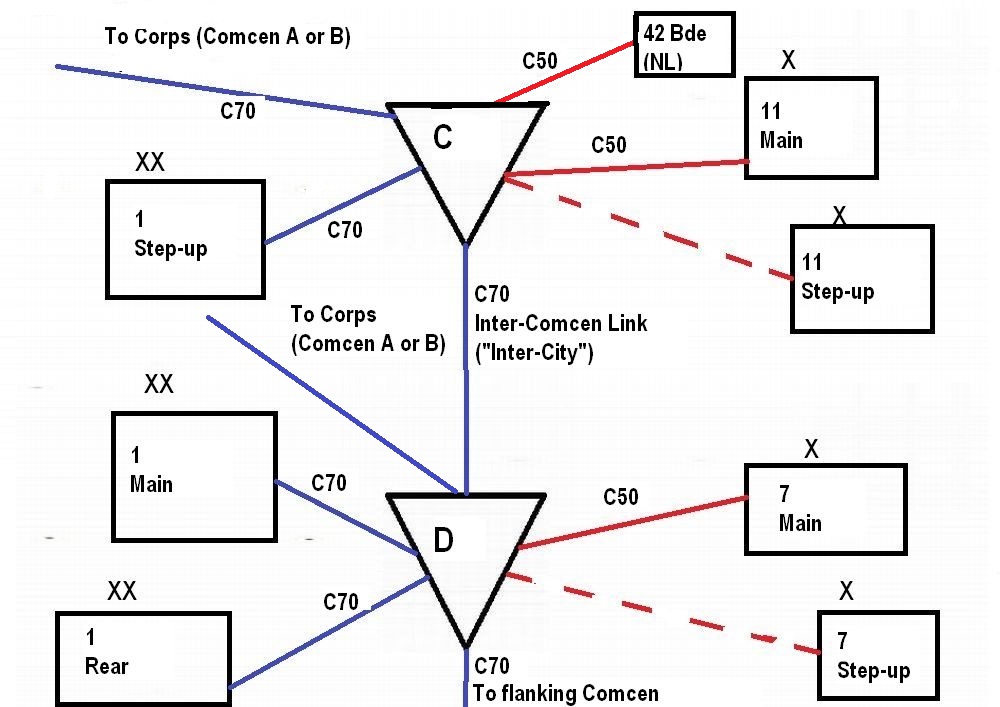
1 Squadron had the Comcens, Comheads and radio-relay detachments.ie in
1 Division, 1 Squadron had Charlie and Delta Troops . Charlie TP
had the equipment for Comcen Charlie, and Comhead for Division step-up
and rear HQ as well as a link to 11 Mechanised Brigade, whereas Delta Tp
had the same for Comcen Delta and the Comhead for Division Main HQ , as
well as a link to 7 Armoured Brigade .
The main equipment were message centres in 4 ton containers, Auto40
exchanges (also in 4 ton containers), and C50 RR detachments for links
to brigade, and C70 for links to Division HQs and Corps Comcens. A single
C50 detachment with three banks of equipment was held in each troop as
a relay vehicle.
The main radio-relay vehicle was the Bedford RL. This had a pallet
holding a mast, spare mast (plus a third for relays/double-anchors), an
antenna stowage cage (C50 only), 2 3.1/2KVA generators (plus 4 fuel cans),
a 1 ton container with either 2 or 3 banks of equipment. Dingo (the relay
vehicle for Delta Tp), when loaded out as per SOP7 (including weapons,
ammunition, fuel, rations, personal kit and 3-man crew) weighed in at 13.½
tons! (the vehicle had an MLC of 9).
At corps level there was a 180-line automatic telephone exchange
(a second was held at the School of Signals for training and Corps technical
reserve) in a 4 ton container. There was also a TARIF container (Telegraph
Automatic Routing In the Field). A second unit was held at the trade training
regiment (8 Signal Regiment), also held as Corps technical reserve.
3 Division, being then an airportable unit, had it’s equipment in
airmobile 1 ton containers (Aircon B), which could be towed to the airfield
or mounted in pairs on a Bedford flatbed. The radio relay detachments (C50)
consisted of 2 Land Rovers and 2 trailers. One Land Rover carried 2 generators
and towed the antenna trailer with 2 40ft masts and 2 sets of antennae.
The other Land Rover carried personal kit (sometimes a bank of C50), and
towed an equipment trailer (known as a fish-fryer) with 2 banks of C50.