 |
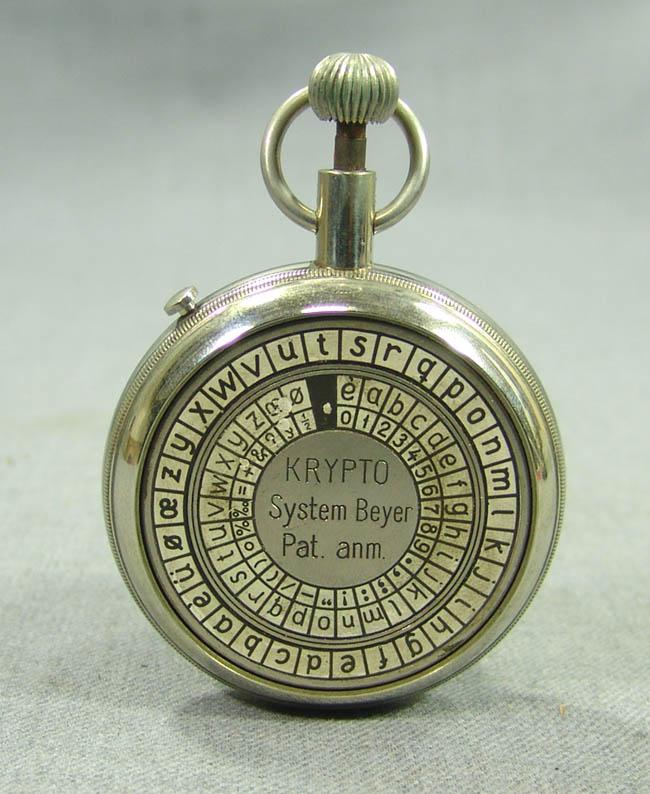
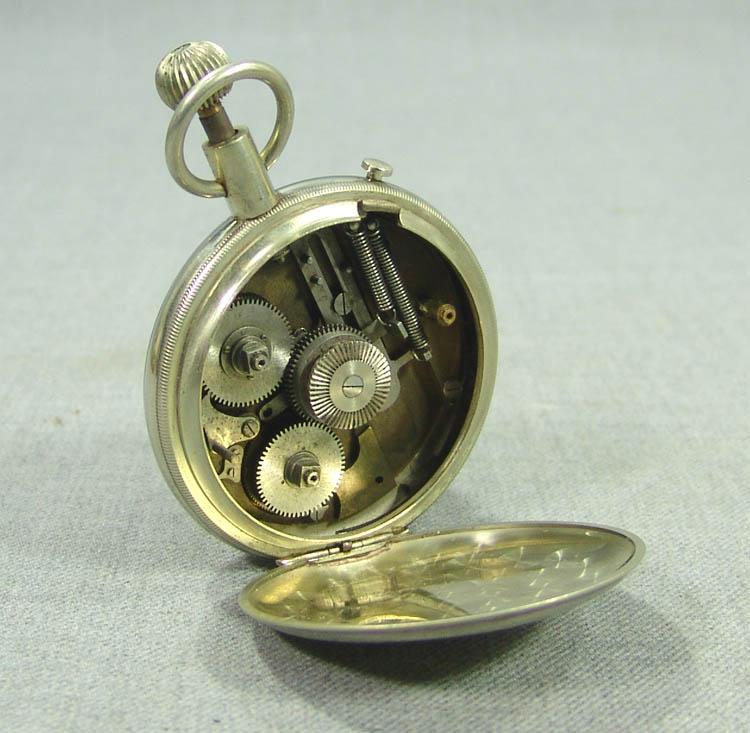
| This pocket-watch style device was made in Denmark around 1932-33. Few of these were produced. As of June 2011, only five of these pocket crypto devices are known to exist. |
 |
 |
| All photos in this table via E-bay |
Danish Beyer "Krypto" and "Krypto Magnum"
A Revolutionary Code System.
A Danish Invention Making Code Books Unnecessary.
(From Denmark Abroad Magazine, August 1933, Vol 27)A Danish invention has just been perfected which seems likely to become an export article with enormous possibilities. The invention consists of a mechanical device to do away with the codebooks which hitherto have been necessary to all who telegraph in a language which only the initiated can read. Code books have this defect that if one book in a private system is lost, an entirely new one has to be compiled which means a great loss of time and money.
The new Danish system "Krypto" does not have that drawback. The machine may may fall into other hands, even those of the finest experts, but there would not he the slightest possibility of their decoding the cipher unless they also possess the key, which consists of two chosen numbers and two chosen letters.
The company owning the manufacturing and selling rights is A/S The Danish Cipher Machine Co. Ltd., of Copenhagen. Their leader is the well -known Danish Tokio pilot Captain A.P. Botved. The system is based upon the theoretical calculations of the late A. Kohle, a Danish engineer. He was quite a genius on this domain and had for instance, compiled the codes used in the Danish Foreign Office and also in other countries. During WWI he was called over to London to assist the British Admiralty in altering its secret codes. One of the officials of the Danish State Railways, P.G.G Beyer succeeded in putting Kohle's theories into practical use. In conjunction with Captain Botved and the Danish Army Technical Corps, the mechanical part of the problem was then solved.
The company is now making two types of cipher machines: a small one about the size of a pocket watch and a larger one working in combination with two teletypewriters. The two types can correspond with one another so that the cipher arranged by means of the small machine can be decoded by the larger unit and vice versa. The system of the larger machine is particularly ingenious. When a telegram is written on one machine , it comes out in code on the other; thus if the cipher message is copied on the one machine, the other writes it in plain language. The certainty of the system is considered to be perfect and the coding systems may be altered indefinitely.
HOW THE SYSTEM WORKS.
The device consists of two disks, or rings carrying two dials divided into 26 or 30 slots in which the alphabet is written. - either in alphabetical order or in any other order that is chosen. An inner dial carries 26 or 30 additional slots bearing figures and punctuation marks. The disks are moved in relation to each other by means of two springs, rotation being set in motion by depressing a release spring. The movement is stopped by means of two wheels revolving on pivots or cam wheels arranged with intermediate spaces of unequal size which are numbered. The apparatus is always ready for use with the various springs being rewound automatically.
Thus, the possibility of decoding messages encrypted on the Krypto device are extremely small as may be seen from the following figures: the letters on the paper dials may be set in 7034 x 10^61 combinations; the cam wheels (in present type with nine or ten spacings) may be combined in 62478 x 176990 different settings. In order to arrive at the commencing position for a certain period of letters, 80910 different combinations would have to be tried before finding the right one.
The commencing position of the apparatus (the key) consists of two numbers and two letters ( ie 46pm) .This means that the left hand cam wheel is rotated to the figure 4. the right one on figure 6 and the letter 'p' set opposite the letter 'm' on the inner dial. The apparatus is now ready for ciphering or deciphering. In ciphering, plain language is read on the strip carrying both letters and figures and conversely in deciphering. From this it is apparent that the cryptogram will contain letters only, while the deciphered text may contain letters, figures and punctuation marks.
KRYPTO MAGNUM
The "Krypto Magnum" ciphering machine embodies exactly the same ingenious principle as the "Krypto" pocket edition and be used interchangeably with the latter. Thus messages may be ciphered with "Krypto Magnum" and deciphered with the "Krypto" pocket type and vice versa.
"Krypto Magnum" appears in a somewhat different setting to his little brother, being built into two specially adapted typewriting machines and requiring an electric current either from a mains source or from batteries in order to operate the "Krypto" mechanism.
All that is necessary in using "Krypto Magnum" is to write the plain text on one of the typewriters. The equivalent cipher text will then be written automatically by the other typewriter. To decipher, it is only necessary to invert the process. The time taken for ciphering or deciphering depends on the speed of the typist. If necessary, the two typewriters may be placed apart even in two different rooms so only that one person at the dispatching or receiving end sees either the original or its transcription. When the current is not switched on, the two machines may be used as ordinary typewriters.
EXPORT CHANCES
There is no doubt that the more wireless telegraphy develops, the more use there will be for codes. The position at present is that anybody who can read rapid telegraphy can tap messages sent by wireless. Thus there would seem to be great chances for the new Danish machine.
After having "prepared" the Danish market where the machine has been well received, the company has organized comprehensive plans for export to every country in the world. The selling organization is almost complete in all countries, whilst the machines are being manufactured by the Danish Army Technical Workshops. The typewriters used are made by NORDEN. Governments , commercial firms, the press and many others will require the "Krypto" and in fact trial orders have already been received from the governments of ten countries. These trials have come up to expectations.
|
| This pocket-watch style device was made in Denmark around 1932-33. Few of these were produced. As of June 2011, only five of these pocket crypto devices are known to exist. |
|
|
| All photos in this table via E-bay |
 |
 |
 |
 |
| This example of the Beyer "Krypto" device is owned by John Alexander. (All photos in this table by John Alexander) |
 |
| This Bayer device is a variant. Note that the innermost ring contains numerals only and is double spaced. (Photo provided by Anders Pettersson) |
Contributors and Credits:1) John Alexander <jalexuk(at)enigmaandfriends.com>
2) Michael Graham <counterforensics(at)mac.com>
3) NY Public Library via David Hamer, NCMF
4) Anders Pettersson <anders.a.pettersson(at)gmail.com>
Oct 14/18