HURON TAKES GROUND ON PAENG YANG DO
- For the large majority of Huron's crew,
the Far East was a first. We sailed out of Halifax on 29th April 1953 and
anxious to see many ports of call before reaching Sasebo harbour Japan
then Korea. From the start, as soon as weather permitting, it was
damage control and manuevering exercises. These were to become more intense
as we proceeded to Korea. However, a stop in Miami took some thoughts off
the Korean war for just a while. As we reached Balboa, the
eastern approach to the Panama Canal, we experienced a very hot,
humid sail through the canal starting at Gatun Lake and into the Canal
Zone. Temperatures in the engine room platform were in excess of 30 degrees
C.
The water was full of dead and cut trees from the days of construction which I assume, the bridge avoided with caution. A few watches later, we arrived in Panama City but the marine traffic and the wait in the canal for a position in the locks made the arrival in city very welcome one. A cool beer was sought and warnings of conduct in town became evident when A. Stevenson sought an ash tray for souvenir from a bar. When we left the tavern we found ourselves surrounded by Panamanian police with guns drawn. They were aware of the borrowed ashtray. We gave back the ashtray to the police immediately and a stranger, possibly a diplomat, said a few words and police put the armament away. It was a scary experience. Later someone told us we were very lucky.
Huron left the Gulf of Panama and set course northward, following the Central American coastline. We took on Bunker 'C' fuel at Manzanillo, Mexico with a 6 hour stopover. Some shore leave was allowed. The fueling party did not anticipate the slow fueling process since the grade of oil was like tar and as it entered ship by gravity feed. After a couple of days and damage control exercises, we entered San Pedro, California. A couple of crew met movie star Gordon McRea here and he bought them drinks as the story goes.
While sailing from the US west coast to Pearl Harbour, Hawaii, we saw many depth charge exercises and shooting practices. The off watch personnel played many card games and also read. I even learned the fine art of “stuke” or blackjack and as a novice, took many chances and ended up with a winning pot of about $120. On my pay, that was a fortune! I instantly became the mess buddy guy, however, I was sending most of my pay home to my wife of course and with two children, she needed every cent of a killick's pay.
When we reached 'Pearl', I let loose. Three of us drove to Wakaki Beach in a U-drive car. In those days, the U.S. mess at Pearl offered free drinks if you got past three Singapore Slings. It was a good thing we enjoyed Hawaii because days that followed at sea were horrendous with more workups for Korea.
There were many gun practices off Hawaii and torpedo runs. One would no sooner leave a hot watch below than before hitting the sack it would be Hands to action stations- ship in state 1A etc. There were also many small arms shoots. I was a motor boat stoker on one such torpedo shoot and we had to retrieve a spent torpedo in pretty choppy sea. The motor boat road rode the waves up and down but what was worse was the dang torpedo also did the same - one time we saw it ,the next it bobbed down below the water. The boat came right next to the spot of recovery and the torpedo shot out of sea just inches from my hull. We managed to retrieve it and I spared myself from becoming shark bait..
From Hawaii we sailed to Kwajalien then to Guam. We reached the Korean Theatre of War on 18th June and finally Sasebo Harbour Japan. HURON then relieved HMCS HAIDA which had just finished her first of two tours of duty. HMCS Crusader was ending her first tour in Korea as well. Huron, as did others, anchored out and it was the liberty boat for shore leave. Advice from the departing ships was “when the gals start looking like your sister - it's time to leave mate !
Our patrols up the Korean west coast on carrier patrol proved dull and very monotonous so our return to home port was most welcomed and the opportunity to knock back some Asahi beer. We looked forward to some action and eagerly waited to join the “Trainbusters” Club - which was in our case, was only one night. We had a happy ship and excellent captain in Commander Chenoweth.
An omen to the upcoming fate of Huron was the loss of our mascot “Bubbly” ashore before sailing. We adopted Bubbly in Halifax. She became a favourite especially at tot' time. Our patrol took us on a coastal run north to south of about 40 miles to Island of Yang Do which was under U.N. protection.
I was on the first watch (2000 hrs to 2400) in the Gearing Room and had just got into my hammock when I was thrown to the messdeck. HURON had grounded. This would be my second time to ground in the Navy! The first time was aboard HMCS Magnificent in Whites Cove N.S.
But this hit was much more resounding. It was just after midnight. We, in the off watch, scurried up ladders in shorts or whatever to find out what had happened. We saw a very dark night and virtually nothing but a huge dim object of land at the bow. The gunnery officer had opened the gun locker and ordered crew to the bow area to stand guard. It was not only dark but thick with fog. Land batteries were not far away but we could hardly see the Island we hit let alone the mainland.
The bridge immediately piped action stations and damage control parties to muster. We had all practised this action for weeks so all knew exactly where to go. My station was aft. However, we were selected as needed to do work as required. It involved shoring the damaged areas of the bow compartments aft to about the break of foc'sle area. The paint locker was flooding and tanks below open to the sea.
I and others were taken from the aft Damage Control station to the forward lower mess to shore bulkheads using 2” by 4”s. The engineering team was already pumping water from tanks in the damaged forward portion of the ship to aft tanks. This assisted in raising the front of the ship and brought the aft end deeper. We were ordered to jettison any unnecessary items of weight and without further thought, AB Stoker Wilberforce and a couple crew grabbed the heavy wardroom piano lugged it up to the uppers and flung it into sea. Ships anchors and cables were left to the island and the forward magazines forward were loaded to the stern.
We spent many hours with shoring and Damage Control duties. I guess it was harder on the first watchmen for tiredness because we had been just standing a 4 hour watch and looking forward to some sleep in hammocks With dawn soon to break, we were fearing that the North Korean shore batteries would open fire - however the fog continued to remain as our ally.
Crippled as we were, the ship did an astern. A
US tug and other ships arrived at the scene. Finally we got off the
rocks. As we got into deeper water,
the shored bulkheads, deckheads were continuously monitored.
Investigation by engineering staff could be made
better at sea, away from the danger of coastal batteries. Huron had air
cover as well as did the other vessels in the vicinity. We were met much
later by a sea-going drydock of immense size. Huron however could not access
the drydock due to a bent SONAR dome which could not be raised in
order to enter the drydock gate.
A sea going tug attempted to break the dome off but couldn't. This meant Huron must now proceed to Sasebo harbour for repairs BUT stern first due to heavy bow damage. This also placed an excessive strain on propellor shaft bearings which caused them to heat up. To stabilize the situation, a top speed of 3 knots was imposed but it took seven days before we entered Sasebo harbour and drydock. The tug let us go at the entrance to the harbour and we entered on our own, bow first.
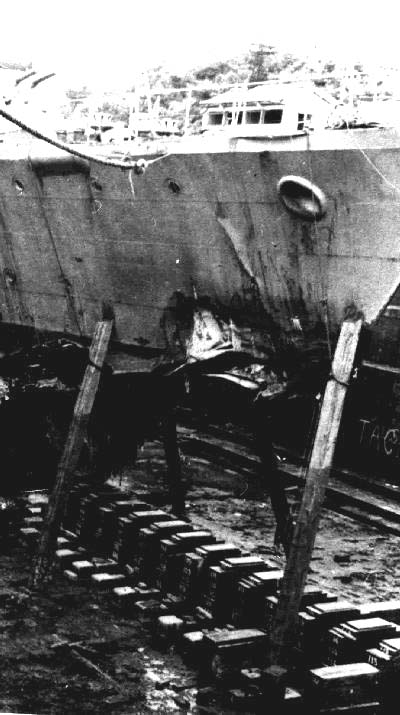 |
| Huron in the drydock at Sasebo, Japan. This would the second of three bow prangs suffered by the vessel since her commissioning, The next would occur in 1958. (Photo credit unknown) |
- The cause of grounding was the 2nd officer
on the watch. He was responsible for setting the ship's course but
ignored radar reports of land ahead and relied only on his calculations.
Many of the crew were sent back to Halifax to attend the resulting enquiry.
The Sasebo drydock put a temporary cement bow
on the ship. Huron's remaining crew spent the next 11 months aboard carrying
out trials and work ups, then performed NU peacekeeping duties off the
coast of Korea- this, along with visits to Hong Kong, Kure and other
Japanese cities until departure. Huron the sailed back to Halifax
on February 2, 1954 via Singapore, Ceylon India, through the Suez canal
to Med' and the Atlantic. This completed a circumnavigation of the globe
for Huron. We arrived back in Halifax March 17th on a rainy, cold day.
My wife and two children were on the jetty. I was pleased and so
happy to see them. Marie was noticed by the Admiral`s wife from her
car and Mrs. Bidwell asked her to wait with her, out of the wet cold air
until the ship tied up.
|
|