DECCA CANADA
DECCA OPERATIONS IN CANADA
In the mid 1950's, The Decca Navigator Company of London, England,
was run by Harvey Schwartz a real dynamo at marketing. The company was
a subsidiary of the massive Decca complex controlled by Sir Edward Lewis.
Schwartz's big success had been the utilization of the system in the D-Day
landings. It was his dream to expand Navigator throughout the civilized
world and in particular, to the United States.
Roy Mitchell, an ex-RAF squadron leader and an associate of Robert Watson-Watt,
the British scientist credited with the development of radar had been selected
to lead Decca into the North American market. He had already convinced
the Bendix company to consider a North American licence. In the winter
of 1956, Roy moved from London, England to Toronto, Ontario and established
a Canadian office for Decca Navigator.
In 1957, the Canadian Coast Guard started to evaluate Decca Navigator
for eventual certification as radio navigation aid for Canada. Chains were
built in Newfoundland, Nova Scotia and Quebec for this purpose. Business
was booming. Around Christmas 1958 when everything was going great, Roy
Mitchell announced that Decca was about to withdraw from the North American
market and the Bendix Corporation had taken over the licence. That meant
the Decca Navigator division had to be moved to Ottawa because it would
be managed under the wing of Computing Devices Canada (CDC), a Bendix subsidiary.
Roy Mitchell was off to New York City to take over the Decca Radar Corporation
there. By January 1959, the move to Ottawa had been completed but the transition
was rocky one having encountered problems between senior management and
staff. The basic issues focused around management's fundamental lack of
understanding about marine sciences.
Within a short time, business was booming and CDC landed contracts with
the Department of Transport, the Hydrographic Office and the Department
of Mines and Technical Surveys. The company started conducting Decca Navigator
tests with the Royal Canadian Navy and the United States Navy. The Canadian
Navy adopted Decca and used it until Global Positioning System became the
primary navigation system. By 1961, the Canadian Coast Guard had
completed the certification of the Canadian chains and they entered service.
In the autumn of 1965, the Decca division was prospering, but the main
business operations were somewhat less than profitable. Bendix, who owned
60 percent of the company decided to go public. It was a good deal for
the stock brokers, but did absolutely nothing for the bottom line. Massive
changes were needed but no one was fired. People were just moved around.
Expenditures stayed the same and the income grew even smaller. There were
also sorts of wonderful ideas and systems floating around in people's minds
but without those defence contracts CDC's survival was in jeopardy. The
most lucrative marketplace, the U.S. military was to be denied because
of the "not invented here syndrome".
CDC eventually became part of the General Dynamics group. Today, the
company is a supplier of military electronics to both the Canadian
Department of National Defence and to the United States. The last Decca
chain in Canada having closed down in 1986, ended Decca Navigator
operations for CDC and signalled the end of an era.
COMPUTING DEVICES OF CANADA
Reprinted from Decca Navigator News November 1964
Computing Devices of Canada Limited commenced operations in 1948. Their
first big job being to develop a tactical war games simulator for the Royal
Canadian Navy. In 1956, through their affiliation with the Bendix Corporation,
they obtained the exclusive Canadian Licence for the Decca Navigator System
and operated all the Canadian Decca Navigator Chains.
In 1960, after the Chains had been sold to the Canadian Department of
Transport, the operation of the Chains also reverted to the Government.
There were 163 receiver leases at that time.
With the introduction of the Decca Navigator Mark XII and the prospects
of a substantial number of orders for this equipment in Canada, Computing
Devices decided to produce the equipment on their assembly lines using
as much Canadian material as possible. In January 1964, manufacturing commenced
and 150 sets were planned for the first eighteen months of production.
The first Canadian built Mark XII came off the production line on 28th
February 1964 and was installed aboard the vessel 'Foundation Venture'.
At that time, sets were coming off the line at the rate of three per week.
The plant at Bell's Corners, now a suburban community within the
city of Ottawa, occupied 200,000 square feet and a further 28,000 square
feet was scheduled to be added in 1964. The staff numbered 1,200 of whom
400 were engineers, scientists or technicians and the growth chart indicated
a total of over 2,000 would be needed within the next four years.
The Marine Organization of CDC operated depots at Montreal, Halifax,
Sydney, Yarmouth, Lunenburg, and Burin in Newfoundland. Service for Decca
Navigator equipment was also provided through agents located in St. John's,
Newfoundland; St. John, New Brunswick; Grand Manan, New Brunswick; Prince
Edward Island; Lameque, New Brunswick, Seven Islands and Quebec City..
As of September 1964, there were 350 receivers on lease, a combination
of both Mark V's and Mark XII's.
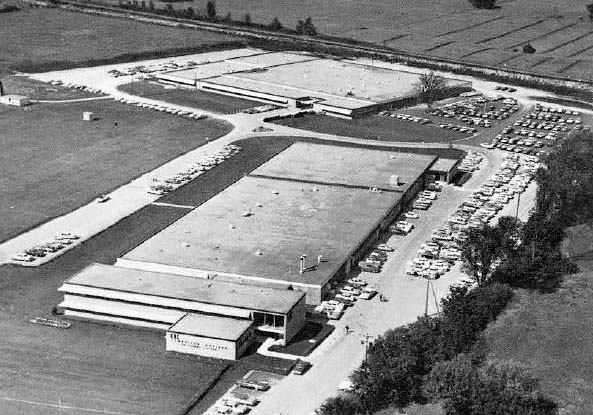 |
| CDC's production facility for their entire product line. It was located
in Bell's Corners, Ontario which is now part of the City of Ottawa. |
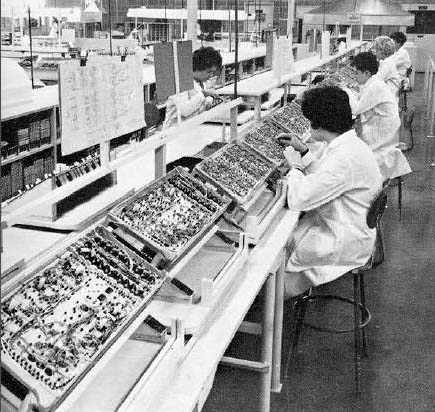 |
| Here, a row of Mark XII discrininator chassis are nearing
final assembly. |
 |
| A technician is calibrating a receiver chassis and performing
final checks. |
All photos in this table from Decca Navigator News
, November 1964. |
DECCA MARINE CANADA
From Decca Navigator News , September 1976
With the recent acquisition of ComDev Marine from
the Computing Devices division of Control Data Canada Limited, Decca has
brought together a coast-to-coast organization for the sale and servicing
of all Decca marine products.
Decca Radar Canada Limited and The Decca Navigator Company (Canada)
Limited were set up in 1953. An extensive sales and service organization
to meet the demand, particularly for radar was established with headquarters
in Toronto, to be followed by a time of steady expansion
In 1957 the manufacture, rental and servicing of shipboard Decca Navigator
receivers passed to Computing Devices of Canada under a prior North American
licensing arrangement. With the transfer of some Decca personnel from Decca
Canada and the UK as a basis, Computing Devices Company (CDC) formed a
marine electronics sales and service organization in the Atlantic Provinces
and at the same time were also appointed representatives for Decca Radar
equipment for this area of Canada. Concurrent with these developments Decca
Navigator Chains of Transmitting Stations were erected in Eastern Canada,
and as a result of proving trials, four Decca Chains were purchased by
the Federal Ministry of Transportation provide better facilities for increased
shipping expected with the opening of the St. Lawrence Seaway and to assist
the development of the Eastern Seaboard fisheries. The Canadian fishermen
in particular rapidly equipped their vessels and CDC commenced manufacturing
receivers.
At the same time a heavy investment was made by CDC in providing service
stations even in remote parts of Newfoundland and Nova Scotia. Computing
Devices added to their marine product range and operated under the divisional
title of ComDev Marine. Currently some 500 local fishing vessels are equipped
with Mk 12 or Mk 21 receivers.
Decca Radar (Canada) Ltd since its establishment has achieved great
success in meeting the demand in Canada. In addition to a wide range of
shipborne radars - no less than 28 new Decca equipment types were introduced
in the 1970s- the Company has been active in developing and supplying
advanced equipment for Vessel Traffic Management facilities and for engine
room control and monitoring systems.
Decca Marine, incorporating Decca Radar and ComDev Marine, is based
in Toronto with regional offices at Dartmouth, Montreal. and Vancouver
and will now cover Canada on an integrated national basis with some 50
sales and services outlets for Decca Navigator, Decca Radar, ISIS, Loran
C, Decca Autopilots, Microtecnica Gyros, Elac Echo Sounders and a range
of marine communications equipment.
Decca Marine is now the largest marine electronics organization throughout
Canada.. Government Agencies, shipping and fishing interests are assured
of an even better service as a result of this consolidation.
INITIAL CHAIN CONFIGURATION AND HISTORY
On the 10th and 11th December 1975, ComDev Marine the Canadian licensee
for the Decca Navigator Company Limited, was invited to give a presentation
to the Ministry of Transport (Marine Telecommunications & Electronics
Branch) on the Decca Navigator System in Canada and system developments
internationally. The presentation had a three fold purpose:-
i) To review the history of the Decca Navigator System in Canada and
focus on the current (1975) situation on the East Coast.
ii) To review and discuss previous, on-going and future system developments
internationally.
iii) As a result of (i) and (ii) to provide the Ministry of Transport
with detailed proprietary technical data on the Decca Navigator System
to assist the Ministry in its study and evaluation of a suitable public
service marine navigation system for Canadian waters in the 1980-1990 time
frame. An excerpt from this document illustrates the chain history.
"The first Decca Chain in Canada was installed in 1956 to fulfill high
accuracy survey requirements of the Department of National Defence (Royal
Canadian Navy) and the United States Navy over an extensive area off the
south coast of Newfoundland. The Decca hyperbolic system was selected in
preference to the Lorac System which had been used worldwide for survey
control since 1952 by the U.S. Hydrographic Office.
Chain 6B (the RCN chain) was sited along the south coast of Newfoundland
between Cape Ray and the Burin Penninsula and some use of the chain was
made by TransAtlantic merchant shipping on an experimental basis during
1957.
In 1956, the Decca Navigator Company and Computing Devices Company proposed
to the Department of Transport the installation of a Chain in Nova Scotia
on a trial basis to determine user demands. The latter agreed to this two
year trial, at no cost to the Department and Chain 7C was installed in
1957, (190 Series equipment) An authorized number of vessels - mainly fishing
vessels, were fitted with Mk V receivers as soon as the chain was in operation
in August 1957 and lattice charts were available. TransAtlantic shipping
bound to and from east coast ports were of course already fitted with Decca
receivers for navigation in European waters and could also take advantage
of the Nova Scotia Chain. It is emphasized that this was all activated
as a private venture in Canada at considerable financial risk and with
no guarantee of permanency. Any possibility of permanency depended upon
user acceptance.
Further financial risk was incurred by the Decca Navigator Company and
Computing Devices Company in November 1957 when a second Decca Chain -
9C, was installed on a trial basis in the Montreal - Quebec City area.
This was one of the first Mk 10 Multipulse chains (820 series equipment)
and as such was specifically for airborne use in the terminal approaches
to Montreal. Shortly thereafter the East Newfoundland chain 2C was also
established on a trial basis for marine use using 820 series equipment.
In 1959, user interest and acceptance from both the Canadian fishing
industry and deep sea shipping was highly favourable and on completion
of this successful trial period, the Department of Transport agreed
to purchase Chains 2C, 7C and chain 9C for marine use [1].
It is of significance that at the I.C.A.O. Meeting on Airborne Navigation
Systems for North America held in 1958 in Montreal, selected VOR,
DME and TACAN systems in preference to Decca for enroute and terminal navigation
by aircraft. This decision effectively excluded the Montreal - Quebec City
Chain 9C from commercial airborne use. Also, as this Chain's eastern high
accuracy coverage only extended to Father Point Quebec and as ships were
under positive control by pilots from this Point up river to Montreal and
beyond, it was logical to re-site this chain to cover a major portion of
the Gulf of St. Lawrence to provide accurate positioning at sea. This was
completed in 1961 and became the Anticosti chain.
Between 1961 and 1964, the Dept. of Transport accepted responsibility
for the continued operation of the RCN Chain 6B and when the naval requirement
for the chain ended, new chain equipment was purchased by the Department,
new sites were established and Chain 6B was re-positioned to cover the
approaches to Cabot Strait.
 |
| Circa 1956-1957: This was the initial configuration for the
Decca chains in Canada. The Quebec chain (9C) became operational in 1957
but in 1958, a Montreal ICAO meeting closed it down because VOR,
DME and TACAN systems were selected in preference to Decca for enroute
and terminal navigation by aircraft. The equipment was reloacted
and it became the Anticosti Chain 9C.
The stations of the West Newfoundland chain were built for the Royal
Canadian Navy and became operational at the sites shown above. When the
naval requirement for the chain ended, the chain was closed
and the equipment was relocated to cover the approaches to the Cabot Strait.
Also shown are the Master and Purple DECTRA stations which were incorporated
into the East Newfoundland chain. DECTRA was discontinued in the
late 1960's when inertial navigation systems became the standard airline
long range navaid.
The Quebec chain had the master around Quebec City with the northern
slave near Chicoutimi , the western slave near Trois-Rivières and
the southmost slave in the vicinity of St. Georges. For the Western Newfoundland
chain, the master was sited at Recontre West with the eastern slave sharing
the green slave of the East Newfoundland chain. Port-Aux-Basques remained
as slave fpr the 6B chain. (Map courtesy Decca Navigator News via Walter
Blanchard) . |
 |
| On August 19, 1957 the first general useage Decca chains were officially
opened by The Hon. George Hees, Minister of Transport at Halifax. (see
above map). Evaluation trials began shortly therafter by the Department
in order to determine the value to shipping. (Photo courtesy Decca Navigator
News via Walter Blanchard) |
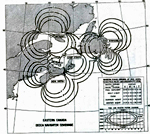 |
1964: This map shows the random fixing
errors at sea level. Click to enlarge. (From the collection of John
Molloy-Vickers) |
STATION NAMES
 |
| The final configuration of the chains in Canada. (Graphic courtesy
Decca Navigator News Sept 1976. Modified by Jerry Proc) |
ANTICOSTI CHAIN
Shortly after the Nova Scotia chain was opened, the Anticosti Chain
became operational. This chain was officially opened by Mr. John Baldwin,
Deputy Minister of Transport for Canada. The ceremony was held in conjunction
with the annual meeting of the Air Industries and Transport Association
of Canada. It was announced that the Canadian military would carry out
trials of their own using Fairchild C-119 aircraft fitted with DIAN. The
Royal Canadian Navy started assessing it for air-sea rescue work.
NOVA SCOTIA CHAIN
The Nova Scotia chain was the first Canadian chain to open. On August
19, 1957, a ceremony was held in the Nova Scotian Hotel in Halifax where
Bendix-Decca Navigator receivers were exhibited. Practical demonstrations
were given aboard the Prestonian class frigate HMCS OUTREMONT. The
equipment was kindly loaned by the Royal Canadian Navy, the Coast Guard
ship CYGNUS and the RCMP vessel, THE MacBRIEN. All the vessels had
been fitted with receivers and track plotters.
In the course of his speech Mr. George Hees, Canada's Minister of Transport
who had been present at the demonstration in the harbour, said he was "tremendously
impressed" by the possibilities of the Decca system and hoped sufficient
ship owners and airline operators would opt to make it a standard radionavigation
aid in Canada. Premier Bob Stanfield of Nova Scotia said that the people
in his province would certainly endorse the system if it contributes
to safety.
One of the first ships to use the new coverage on a scheduled run was
Canadian Pacific's EMPRESS OF ENGLAND. The report of her master , Captain
C.L. Hauteville Bell, was " The system worked marvelously. We compared
the Decca readings with visual fixes taken from land points and they were
all perfectly accurate". Other famous ships of the day using Decca were
the QUEEN MARY and QUEEN ELIZABETH, the UNITED STATES and the EMPRESS
OF BRITAIN.
After the system was installed, the Canadian Ministry of Transport started
a one year evaluation period to decide whether Decca was to become the
standard navigational aid for Canada. It did become a standard and persevered
until the 1980's.
 |
| This chart shows the actual track of the demonstration run of the C.G.S.
CYGNUS as recorded by her Track Plotter. Note the points of departure and
return are quite distinct. (From Decca Navigator News via Walter Blanchard) |
John Molloy-Vickers adds this final note to the Canadian story.
"After the Manhattan oil tanker had completed a feasibility trip
through the Northwest passage in 1969, interest in oil exploration in the
north started to heat up. CDC and Decca began working on a proposal to
build a main chain for the Mackenzie River delta area. I made a couple
of visits to Ottawa from the UK to visit CDC and the DOT to help with the
planning but it all came to nothing. The costs would have been prohibitive
apart from mast foundation problems".
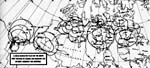 |
If a sea route through Canada's northwest passage
was ever opened up, Decca's Planning Department proposed the chains in
this image. Nothing in this proposal was ever built. Click on image to
enlarge. (From Decca Navigator News, August 1970) |
LAMBDA CHAIN FOR LAKE ONTARIO
In 1971, in support of the International Field Year For
the Great Lakes (IFYGL), a contract was awarded to Computing Devices of
Canada, Ottawa for the rental and operation of a Decca Lambda Survey system
to facilitate positioning of survey and research vessels and aircraft engaged
in IFYGL (1972) operations on Lake Ontario. Field plotting sheet projections
and Decca Lambda lattices were prepared on Central Region's Gerber 22 plotting
table and supplied to Canadian Hydrographic Service Headquarters where
the final field sheets were compiled.
The chain consisted of one master and two slaves along with 13 Canadian
ships and one helicopter suitably fitted to receive the hyperbolic transmissions.
On the U.S. side four vessels and three aircraft were so fitted by
Navigation Systems Inc, Decca's American subsidiary. The Lambda chain would
provide accuracies of better than 200 feet (61 metres). Below is a table
showing the locations , functions and coordinates of the Lake Ontario chain
circa 1971. Additional information on the IFYGL survey can be found in
the April 1972 edition of the CHA publication.
| LOCATION |
FREQ (KHz) |
LATITUDE (N) |
LONGITUDE (W) |
LICENSE # |
|
|
|
|
|
| Eddystone (Master) 0.9 kw |
84.730 |
44 03' 28.818" |
78 00' 28.550" |
XLP200 |
| Grimsby North (Red)
0.9 kw |
112.973 |
43 11' 24.314" |
79 35' 58.053" |
XLP201 |
| Wolfe Island (Green) 0.9
kw |
127.095 |
44 05' 53.394" |
76 26' 19.542" |
XLP202 |
| Port Hope (Monitoring station). |
|
43 57' 37.994 " |
78 14' 30.696" |
|
All stations located in the Province of Ontario.
Baselines:
Red to master - 160,618.05 metres
Green to master - 125,772.79 metres. |
 |
| Lattice chart for the Lake Ontario Lambda chain
The station locations are approximate. . |
 |
Top left: Exterior of Master station.
Top right: Monitor station.
Bottom left: T350T track plotter installed in a vessel.
Bottom right: Interior view of the master station showing the Lambda
transmitters. |
| All photos in this table from Decca Navigator News, October
1972 |
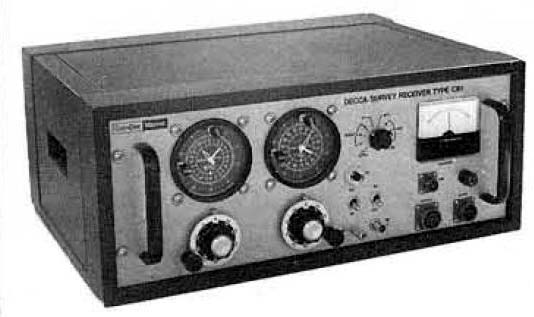 |
| Decca type C81 survey receiver. (From Decca Navigator
News , October 1972) |
DECCA RADAR LOGO
 |
| From Decca Navigator News, June 1979. |
John Molloy-Vickers provides a short piece on the Decca logo.
"The logo with Decca superimposed on a maple leaf belonged to Decca
Radar Canada which was the Decca's Canadian arm that looked after
Decca Radar interests in Canada, the Decca Navigator chains and Decca Austin
Insulators which Decca bought and moved from the USA to Brampton, Ontario.
When Racal took over, Decca Radar moved to Mississauga. Later, Litton Marine
Systems took over Decca interests in Canada. Pat Warr bought what was left
of the original Decca company and it became The Austin Insulator Company
at the same location in Mississauga".
NOTES:
[1] Treasury Board Minutes 552307 dated 25th August 1959.
Credits and Contributors:
1) Walter Blanchard <wb(at)g3jkv.co.uk >
2) John Molloy-Vickers <johnmv(at)sympatico.ca>
3) Decca Navigator News, August 1970.
4) Decca Navigator News, October 1972.
5) Decca Navigator News, June 1979.
6) William Hepburn DX Info Centre <dxinfo(at)cogeco.ca>
Back to Decca Chains Page
May 5/19

