GENERAL
The following excerpt from The Ships of Canada's Naval Forces 1910-2002 provides a brief description of the Bangor Class.
"The RCN had four minesweepers in 1939, Canadian-built copies of the RN's Basset class, and consideration was being given to building more of these when the Naval Staff learned of the RN's newer Bangor class. The Bangor was larger and faster, had much greater endurance, and burned oil unlike the coal-burning Bassets. Accordingly, twenty-eight Bangor class minesweepers were ordered in 1940 and twenty more under subsequent programs. Another six, built at Vancouver for the RN, were loaned to the RCN for the duration of the war. Ten Bangors of the first program were of a smaller, diesel-engine variety and one of these, Granby, survived until 1966. Most of the Bangors were named after Canadian towns and cities; the rest after bays.Like the corvettes, the Bangors were small enough to be produced at shipyards on the Great Lakes, and sixteen were built at Toronto and Port Arthur. The Toronto yard turned out six others of the class for the RN. As enemy mines were laid only once (1943) in Canadian waters, the Bangors were used principally as escorts to coastal shipping or as local escorts to ocean convoys. Sixteen of them, however, assisted in sweeping the approaches to Normandy before D Day, and stayed to help clear German and Allied minefields in the Channel for some months afterward.
Two classes of wooden-hulled ships were built in Canada for magnetic minesweeping, the Llewellyn and Lake classes. None of the latter class had been commissioned by VJ Day, and the ten most nearly complete were turned over to the USSR".
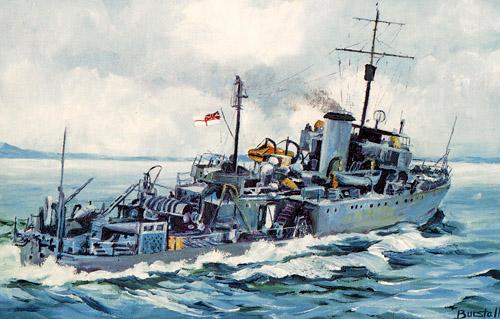
On the morning of 24 December 1944, the Bangor minesweeper HMCS Clayoquot was carrying out an anti-submarine sweep in the Halifax approaches under the command of LCdr Campbell. Near noon, just around "up-spirit" time, the ship was hit by a torpedo when it was some two miles distant from the Sambro Light Vessel. The GNAT torpedo, fired from U806, hit the Clayoquot aft killing the depth charge crew and trapping two officers in their cabins. The ship quickly settled by the stern and sank in 25 fathoms. There was no time to withdraw the primers in the depth charges so they detonated. Sixty-seven of the ships company were picked up from the frigid waters within fourty minutes. (From an original oil painting by Pat Burstall imprinted on a Christmas card of the Atlantic Chief and Petty Officers' Association)
VITAL STATISTICS Length: 180 feet Beam: 28 feet Draught: 8 ft. 3 in. Displacement : 672 tons Top Speed: 16 knots Crew Complement : 6 officers, 77 men Armament: One 4" gun; one 3" gun; One 12 pdr; two 2 mm Oerlikons. Programs: 1939-40; 1940-1941; 1941-42 Bangors built at the Burrard Shipyard in Vancouver cost $620,000. in 1940 dollars.
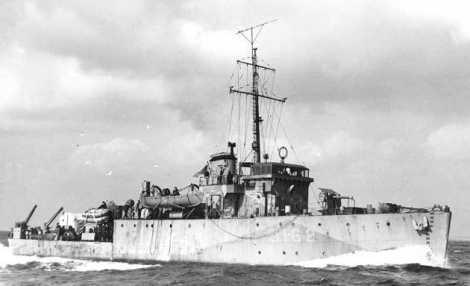 |
| HMCS Wasaga is being used to represent the Bangor Class. Note the SW1C navigation radar (Yagi type) antenna atop the foremast. The Bangors were bluff-bowed ships, very wet in a head sea, and arguably less comfortable even than corvettes in rough weather. (Photo courtesy Naval Museum of Manitoba) |
Ten of the fifty-four Bangor class minesweepers had diesel engines and the rest had steam engines. After WWII, the RCN kept three of the ten after it was realized the RCMP could not afford them. These were:
178 CYQP BROCKVILLE "Barmaid Y"
179 CYQK DIGBY "Mariner I"
180 CYQX Granby "Fancy Ball Y"
The navy used HMCS GRANBY as a Diving Tender based at Halifax, N.S. The other two took on the role of training vessels. When the Korean War broke out the navy decided to recommission eighteen more Bangors:
181 CGKS DRUMMONDVILLE
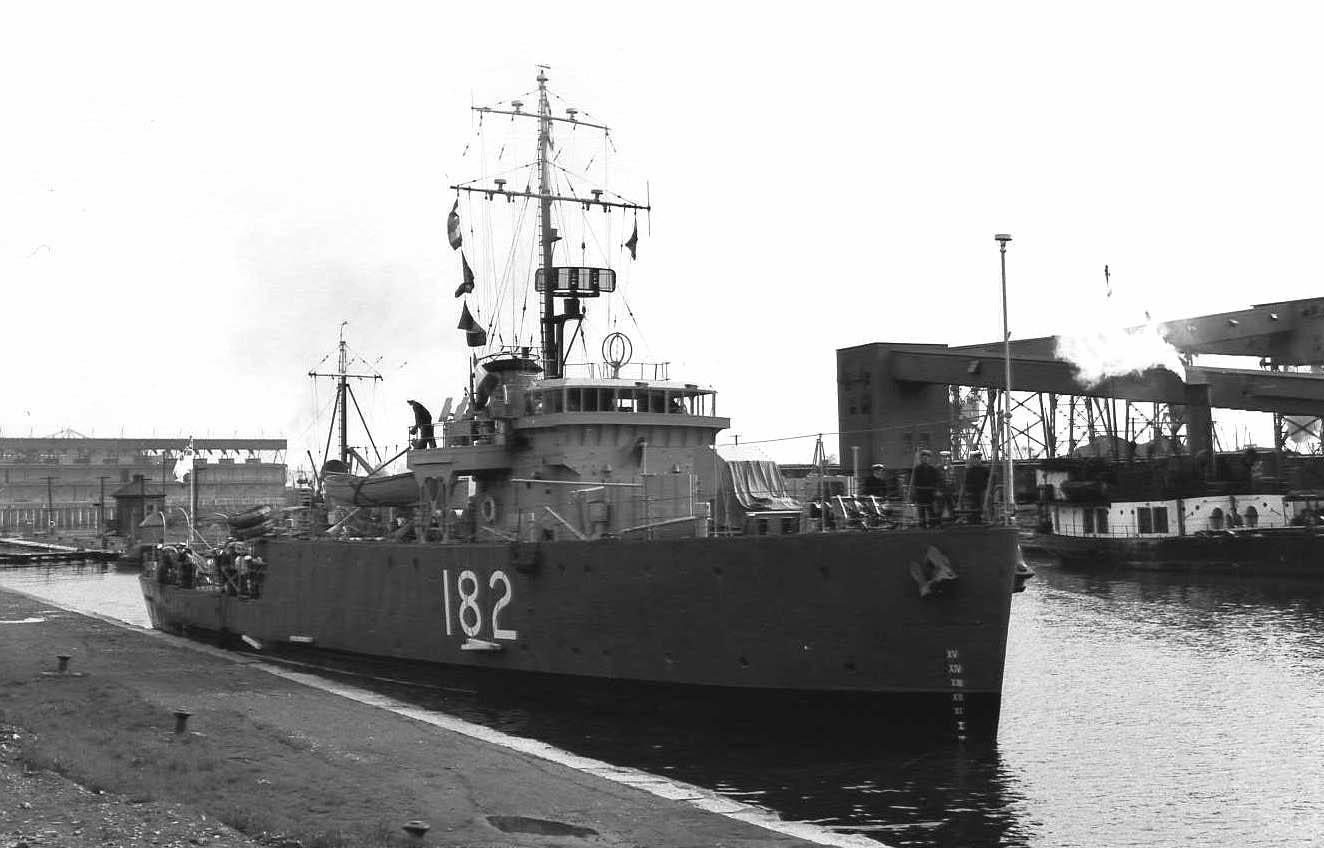
182 CGJT KENTVILLE "Native M"
183 CGRQ PORT HOPE
184 CZDN GANANOQUE
185 CGVB SWIFT CURRENT
186 CGYF MALPEQUE
187 CZCP WESTMOUNT
188 CGLW NIPIGON
189 CZDH MINAS
190 CGRH SARNIA
191 CGXE KENORA
192 CGQV MAHONE
193 CZFI BLAIRMORE
194 CZCR MILL TOWN
195 CGVS FORT WILLIAM
196 CGRC RED DEER
197 CZGF MEDICINE HAT
198 CZJD GODERlCH
Missing from this list is J265 NORANDA CYQJ