KINGSTON Class


GENERAL
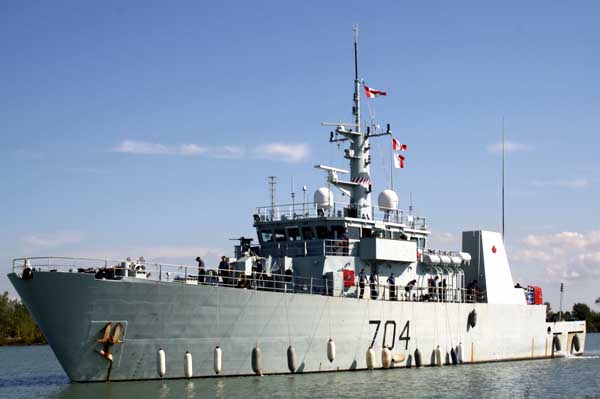
In the late 1980's, the Canadian Navy recognized the need for an effective coastal defence platform that would complement Canada's maritime forces. The decision to build 12 Maritime Coastal Defence Vessels (commonly called MCDV's) has met that requirement. The first of the new KINGSTON Class, HMCS KINGSTON was launched in August 1995 and  last to commission was HMCS SUMMERSIDE on July 18, 1999. Every four months an MCDV joined the fleet. These new ships we also intended to replace a range of old and obsolete ships including Gate vessels, RCMP motor launches and Bay class minesweepers.
kingston_3.jpg
HMCS GLACE BAY demonstrates maneuverability. (Photo courtesy DND)
Versatility was the key to the MCDV with its many interchangeable modular payloads being incorporated into the design. This included mechanical minesweeping systems, route survey and bottom inspection packages. These payloads are complemented by specific team training and logistics support.
The primary role of the MCDV's is coastal surveillance and patrol. This involves a wide variety of missions including general naval operations and exercises ; search and rescue and support to other government departments for activities such as law enforcement, resource protection and pollution control. Training naval reservists is also part of the agenda. By freeing up Halifax-class frigates for more important missions, the MCDV's save the Department of National Defence substantial amounts of money.

Essential to any ship is a well trained crew. The MCDV's are primarily crewed by a maximum of 34 naval reservists and two regular forces personnel. One is a Petty Officer 2nd class who looks after electrical matters while the other is a Master Seaman NET who looks after the vessel's electronics.

The size of crews are adjusted to meet operational requirements. Each crew member will receive extensive occupational training in their specific discipline including communications, navigation, engineering, mine countermeasures,  sidescan sonar and route survey.

Kingston class vessels are equipped with four state-of-the-art route survey equipment packages, equally distributed between the East and West coasts. This technology will allow high quality sidescan sonar imagery of the sea bed, which ,is essential to the development of route mapping and in the detection and classification of mine-like objects. A single bottom inspection payload will provide the capability of inspecting mine-like objects on the seabed using sonar and video sensors mounted on a remotely operated vehicle. This payload is capable of supporting  harbour inspection or explosive ordnance disposal diving teams for mine clearance. The mechanical minesweeping systems fitted on a Kingston class vessel have the capability to provide countermeasures against modern moored mines and also support single and team sweeping operations.

To achieve a more equitable balance of naval assets between Esquimalt B.C. and Halifax N.S., six vessels are assigned to each coast. Their names are listed at the bottom of this document. When the ships were being built it was proposed that during the ice-free months from May to November up to four of the East coast vessels were to be stationed in Quebec City and deployed to the Great Lakes. This never occurred. Even though Fleet School Quebec is right on the St. Lawrence River, there are no appropriate navy facilities there to base ships. The Great Lakes deployment, although fairly regular, is still subject to scheduling on a year by year basis. Hamilton (HMCS Star) was also proposed as a summer MCDV base because it has the third longest jetty in Maritime Command. That plan did not materialize since it would require extensive and expensive upgrades to the existing facilities.
kingston_1a.jpg
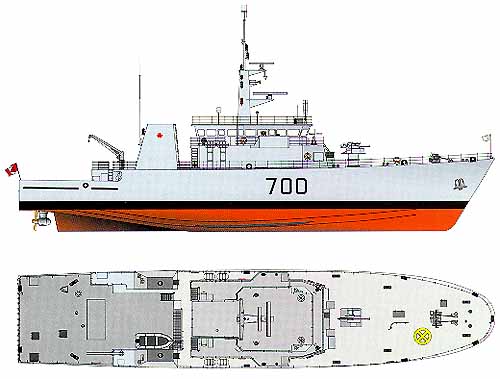
Vessel schematic. (Courtesy Naval Technology Web page)

PROPULSION

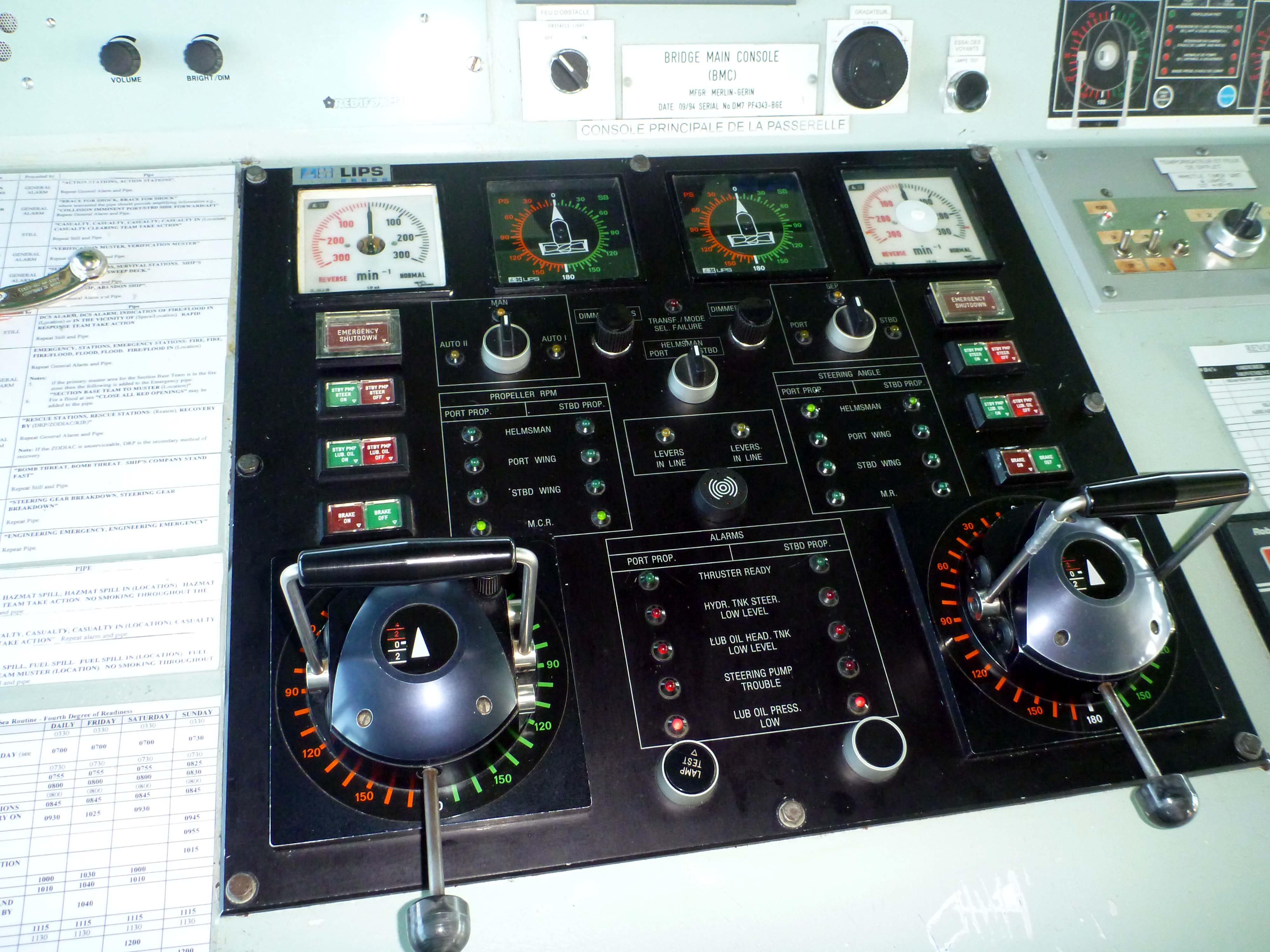
The Kingston-class is equipped with four main Wartsila UD 23V12 diesel engines, four alternators and two Jeumont DC electric drive motors (600 VDC at 1,150 kw ea). Each of the 4 alternators  is rated at 715 kilowatts, 600 volt. 3 phase. Also aboard is a  300 kw auxiliary alternator rated at  300 kW, 440V, 3 Phase.
Emergency power can be obtained from a 120 kW, 440V, 3 PH diesel alternator. Power from the diesel generators drives two LIPS Z drive azimuth thrusters which are are fitted with fixed-pitch, 5 blade reversing propellers. A central control and monitoring system automatically supervises system operation.

When cruising at 9 knots using two engines, a range of 5,000 nautical miles can be expected with a 20% fuel reserve. Mechanical minesweeping is carried out at 8 knots. The crash stop length is 5 ship lengths from a speed of 15 knots.

SPECIFICATIONS
 
Length 55.3 metres
Beam 11.3 metres
Draught 3.4 metres
Displacement 970 tons
Speed 15 knots max (10 to 12 knots optimum)
Range  5,000 nm
Propulsion Diesel electric with two Z drives 
Accommodation  41 berths; 4 officer, 7 Chief and Petty Officers, 20 Master Seaman and Below
Anchor and Cable Two Danforth bower anchor weighing 800 kgs each using 28mm cable
Armament  1 x BOFOR 40 mm.
2 x Machine gun mounts for 50 cal Browning machine guns.

Small Arms – Including C9, C7, Sig Sauer etc

RADIO AND OTHER ELECTRONICS


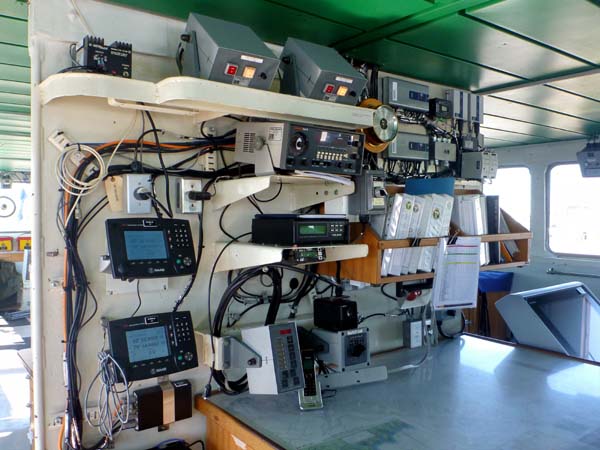
Select this link to see the Kingston Class electronics fit.

RADIO CALL SIGNS

 The pendants and radio call signs for the Kingston Class are as follows:

700 HMCS KINGSTON    CGJX
701 HMCS GLACE BAY   CGAU
702 HMCS NANAIMO     CGAV*
703 HMCS EDMONTON    CGAW  *
704 HMCS SHAWINIGAN  CGAX
705 HMCS WHITEHORSE  CGAZ  *
706 HMCS YELLOWKNIFE CGAY  *
707 HMCS GOOSE BAY   CGBV
708 HMCS MONCTON     CGJC
709 HMCS SASKATOON   CGJG  *
710 HMCS BRANDON     CGJI  *
711 HMCS SUMMERSIDE  CGJJ

* Denotes West coast assignment.

RADAR FIT

kingston_radar_xs.jpg
X band navigation and S band search radars. (Photo by Jerry Proc)
KEY RADAR SPECIFICATIONS
X Band (IEEE)  navigation radar  or I band (NATO)
Frequency - 9,410MHz
Wavelength - 3.1859 cm
Power - 25 kW
Pulse Repetition Rate - 375 to 3000 pps
Antenna - 2.4 metre wide turning at 24 rpm. It is 15.7 m (51 ft) above the waterline
Antenna Weight - 20 kg
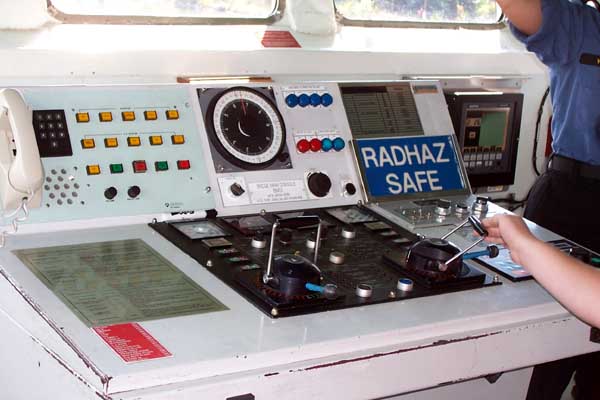
Radiation Hazard (Radhaz) - 1.5 m

S Band (IEEE) search radar or E,F band (NATO)
Frequency - 3,050 MHz
Wavelength - 9.8273 cm
Power 25 - kW
Pulse Repetition Rate - 375 to 3000 pps
Antenna - 4 metre wide turning at 22 rpm. It is 12.2 m (40 ft) above the waterline
Antenna Weight - 65 kg
Radiation Hazard (Radhaz) - 0.8 m


kingston_sband_ant_closeup.jpg
Closeup view of the S-band radar antenna. (Photo courtesy  Rick Bungay)
The X band can be set to short pulse for distances less than 1.5 nm, medium pulse for distances from 3 to 24 nm or long pulse for distances beyond 24 nm.  The X band has proven superior to the S band even at the longer ranges for which the S band was designed.  Consequently, officers on the bridge using the Navigation radar often pick up contacts before the radar plotters in Operations do using the search radar.
kingston_kelvin_hughes_6000_console.jpg
Kelvin-Hughes Nucleus 3 6000A radar console. There are three Nucleus displays - two on the bridge and one in Operations. The forward bridge display is set to master for the X band while the after bridge display is set to slave for the S band while the Ops display is set to master for the S band.  (Kelvin Hughes photo) 
NEW NAVIGATION RADAR FOR THE KINGSTON CLASS

On April 16, 2008, it was announced that Northrop Grumman Corporation has won contracts to upgrade the navigation radars on the Canadian Navy’s Kingston-Class maritime coastal defense vessels (MCDV) and Canadian Coast Guard vessels. The contracts, with a total value of more than $2 million (USD), were awarded to Northrop Grumman’s Sperry Marine business unit.

SNC-Lavalin, the logistics support project manager for the MCDV program, has awarded contracts to Sperry Marine to replace the existing radar units on the 12 Kingston-Class ships. Each ship will be fitted with a suite of interswitched BridgeMaster E X-band and S-band radars with three 340-millimeter flat-screen displays. The installations will take place at the SNC-Lavalin facilities in Dartmouth, Nova Scotia, and Esquimalt, British Columbia.

Sperry Marine also recently received a three-year contract to upgrade the radars across the fleet of Canadian Coast Guard vessels with new BridgeMaster E 180, 250 and 340 radar sets.

kingston_bmaster340.jpg
Bridgemaster E Model 340 deckstand version. (Photo courtesy Sperry Marine/Northrup Grumman)

 
kingston_bmaster_series.jpg
Other versions of the Bridgemaster E series desktop displays. (Photo courtesy Sperry Marine/Northrup Grumman)

 
kingston_bm_display1.jpg kingston_bm_display2.jpg
Displays can be customized by the operator. (Photo courtesy Sperry Marine/Northrup Grumman)
BridgeMaster E Series of Marine Radars - System Configuration

Antennas:
X-Band (3 cm) Scanner (comprising antenna and turning unit)
Antenna Sizes: 4, 6 or 8 ft. (1.2, 1.8 or 2.4 m)
Transceiver Configurations: bulkhead or masthead mounted
Power 10 kW or 25 kW
Factory Fitted Options: Performance Monitor (required for IMO SOLAS vessels)

S-Band (10 cm) Scanner (comprising antenna and turning unit)
Antenna Sizes: 9* or 12 ft. (2.7 or 3.6 m)
Transceiver Configurations: bulkhead or masthead mounted
Power 30 kW
Factory Fitted Options: Performance Monitor (required for IMO SOLAS vessels)
* The 9 ft. antenna is type approved for high speed craft only.
Circa: 2005

Displays:

kingston_bmaster_displays.jpg
(Inage courtesy Sperry Marine/Northrup Grumman)
The display type is the entire flat screen. The diameter which suffixes the model number is the size of the circular area displayed on the flat screen.
ARPA= Automatic Radar Plotting Aid
ATA= Automatic Tracking Aid
SONAR FIT

Kingston class vessels do not carry permanent sonar. Sonar  is only available when the Towfish sonar equipment module is fitted. This is a high-frequency sidescan sonar used for minesweeping. An article dated 7 April 2007 and written by Dan Deeby of the Canadian Press offers some background information on the sidescan sonar.

"The AN/SQS-511, first delivered in 1999 had to be mothballed four years later because of chronic breakdowns. It was designed as a side-scan sonar in the 1990s to take highly detailed pictures of the deep seabed along key waterways and to watch for mines and other hostile devices. No commercial version was then available, so the navy underwrote production of four prototypes for its fleet of  twelve MCDV's with MacDonald, Dettwiler and Associates Ltd. as prime contractor.  The five-metre, torpedo-shaped devices were state-of-the-art, but by 2003 none could be used because a key sensor failed in all four. The failures occurred after the manufacturer's one-year warranty had expired but well before the 10-year projected lifespan of the "towfish," which got their name because they're towed behind the MCDV's.

The AN/SQS 511 system was purchased for operational and training missions despite the fact that it was a prototype, according to one internal briefing note which was obtained under the Access to Information Act. Since its purchase, the four payloads have never been fully operational. The system has been plagued by inoperative electronics and excessive costs for repair.

Originally, the Canadian Navy ordered just two years' worth of spare parts and has since then had to cannibalize one of the prototypes to keep the other three operational. The estimated cost of buying a replacement towfish, now at about $10 million (April, 2007), is considered prohibitive. HMCS Whitehorse has twice smashed its towfish as it tried to make it work even with faulty electronics. The first incident on Oct. 14, 2005, cost $93,000 in repairs after the device crashed into an underwater pinnacle off Vancouver Island. The second crash on June 15, 2006 is expected to cost the navy up to $200,000 in repairs.

In the meantime, much cheaper commercial models have become available -- and have done yeoman's service for the navy, which bought two from L-3 Klein Associates Inc., a U.S. firm.  Klein side-scan sonars have helped locate wreckage from the Swissair crash in 1998, from a Snowbird crash in Lake Erie in 2001, from a Cormorant helicopter crash off Nova Scotia in 2006, and searched for  AVRO ARROW models in lake Ontario.

A navy spokesperson defended the AN/SQS 511, calling it cutting-edge technology not intended to last a long time.  "Back in 1999, it was the best system in the world for its ability to find targets," Lt.-Cmdr. James Hewitt said. "

There has been a new development regarding SONAR and the Kingston class vessels which is detailed in this news release by the Canadian Navy.

Canadian Navy Trials Active Towfish
by Canadian Navy  Staff Writers
Port Coquitlam, Canada (SPX) Apr 24, 2008

ISE's Aurora Active Towfish was successfully towed for the first time from existing route survey equipment belonging to the Canadian Navy aboard a Maritime Coastal Defense Vessel (MCDV) off the coast of Vancouver Island. Built in the 90's for coastal defense, the Canadian Navy's MCDVs were equipped with Route Survey System (RSS) payloads consisting of a high performance multibeam sonar built into a variable depth actively controlled towfish, and a shipboard handling system.

However, over the years, the operation of the variable depth active towfish has become problematic. As the Navy's successful Interim Remote Minehunting and Disposal System (IRMDS) currently incorporates ISE's Aurora variable depth towfish, there was an opportunity to integrate the Aurora towfish with the existing RSS handling device and demonstrate the resulting towing performance from an MCDV. The integration of Aurora with the RSS handling system was extremely straightforward, requiring minimal modifications to the towfish docking mechanism.

This towing trial is part of the Route Survey System Life Extension (RSSLE) project's definition phase. During the three days of towing, over 20 hours of towing was completed in conditions including 25 to 30 knot winds and sea states up to 4. The Aurora towfish provided very stable performance during unfamiliar handling maneuvers, launch and recovery, and operations with both faired and un-faired cabling at a variety of cable scopes, speeds, and depths.

This indicates the Aurora can meet the Navy's towing requirements for the next generation of high performance mine hunting sonars. The Aurora Towfish is owned by Defense Research and Development Canada (DRDC) Atlantic, and has been a part of a working relationship between DRDC and ISE for over 20 years. It is an integral part of the Canadian Navy's IRMDS program. ISE is extremely pleased to be a part of the RSSLE program and looks forward to future integration.
 

kingston_ise-aurora_active_towfish.jpg
Aurora Towfish. (DND photo)
DEGAUSING

The degaussing system from Power Magnetics and Electronic Systems of Rugely, Staffordshire (previously Thorn Automation) provides three dimensional control of the magnetic signatures. The size arrangement and location of the degaussing coils are based on finite element modelling of the ship structure and major equipment fits. The degaussing system consists of a masthead magnetometer which controls the output of the system's power units and the signature, four horizontal "M" coils, eight vertical "L" coils and five vertical athwartships "A" coils.

In reality, Degaussing Control cabinets were only fitted to the first four vessels,  however all vessels are fitted with the coils. Degaussing was not working effectively, so it's no longer supported.

OTHER PHOTOS
kingston_mcdv_oiler.jpg
On 2 September 2003, HMCS Glace Bay (inboard) and HMCS Shawinigan (outboard) are being refueled by the oiler Hamilton Energy at Pier 9, Hamilton, Ont. Both ships were berthed in Hamilton as part of a Lake Ontario cruise and are being refueled prior to departure. (Photo by Jerry Proc) 


kingston_4.jpg
The vessels are capable of carrying two 20 ft ISO containers on the open deck aft. The decks are fitted with the necessary power cables to energize the containers which are mission-specific operational payloads.
(Photo courtesy DND)


kingston_2.jpg
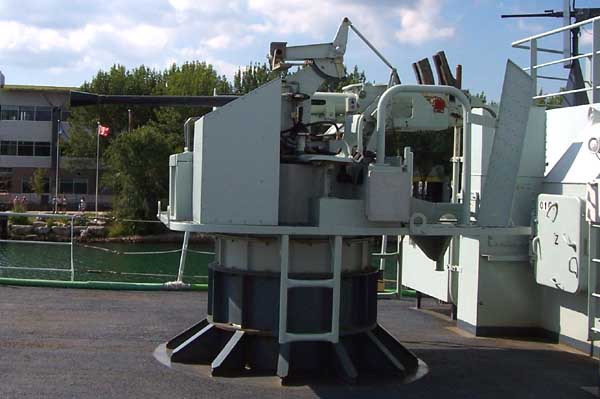
MCDV's are equipped with a Bofors 40mm Model 60 Mk 5C rapid fire gun ( right side), and two 12.7mm machine guns. The Bofors gun is mounted on the forecastle deck and the arc of fire extends forwards by +/- 120 degrees. The machine guns are mounted one either side at the front of the bridge deck. In a depressed position each machine gun fires in an arc of fire of 118 degrees. (Photo courtesy DND)
FOOTNOTES:

[1] ECPINS - Electronic Chart Precise Integrated Navigation System (Offshore Systems)
[2]  SHINNADS -  SHhipboard INtegration NAvigation and Display System
[3] MX Marine products are now branded Northstar.


Contributors and Credits:
1) Ships of Canada's Naval Forces (1910-2001) by Ken Macpherson and Ron Barrie. Vanwell Publishing 2002.
2) Radar copy courtesy Neil S. Bell  <rcnr(at)mountaincable.net>
3)  Spud Roscoe <spudroscoe(at)eastlink.ca>
4) Naval Technology Web site  http://www.naval-technology.com/projects/kingston/kingston6.html and
                                                        http://www.naval-technology.com/projects/kingston/
5) DND Kingston Class Pamphlet.
6) Kelvin Hughes  http://www.kelvinhughes.com:8080/%5CCommPDF%5CRADARNucleus3.pdf
7) Tim Cotey -  Coxswain, HMCS WHITEHORSE (March 2007) <Cotey.TL(at)forces.gc.ca>
8) DND.  Kingston Class "Welcome Aboard HMCS [name] pamphlet.
9) Petty Officer  Rick Bungay, Chief Engineer HMCS SUMMERSIDE.  <rbungay(at)hfx.eastlink.ca>
10)  SQS-511article   http://lfpress.ca/newsstand/CityandRegion/2007/04/07/3943242-sun.html
11) http://www.sperrymarine.northropgrumman.com/news-and-press-releases_details.asp?qsIntNewsID=214
12) Bridgemaster info  http://www.sperrymarine.northropgrumman.com/Admin/Downloads/42/Product%20Brochure.PDF


Back to Table of Contents

April 26/08