| HQ 145-X RECEIVER
 My
father purchased this receiver for me in 1963 when I got my first ticket.
At the time of purchase , it was only three years old and I used it actively
until 1993. Unlike some of the good bargins we find at fleamarkets, this
used receiver cost my dad $Cdn 260 at the time. It was quite a chunk of
money for someone making a $1.25 per hour. For many years, I stored the
original shipping box complete with its Railway Express Agency stickers.
In 1990, storage space became very scarce as a result of building a basement
bedroom. That original box was thrown out, something which I now regret
doing. My
father purchased this receiver for me in 1963 when I got my first ticket.
At the time of purchase , it was only three years old and I used it actively
until 1993. Unlike some of the good bargins we find at fleamarkets, this
used receiver cost my dad $Cdn 260 at the time. It was quite a chunk of
money for someone making a $1.25 per hour. For many years, I stored the
original shipping box complete with its Railway Express Agency stickers.
In 1990, storage space became very scarce as a result of building a basement
bedroom. That original box was thrown out, something which I now regret
doing.
Originally, this HQ145 was not fitted with the crystal calibrator
option. When I ordered one in 1965, I remember month after month of delays
and Hammarlund kept telling my local dealer that production schedules for
the Vietnam war were interfering with civilian orders. After all these
years, this unit is still in pristine condition. |
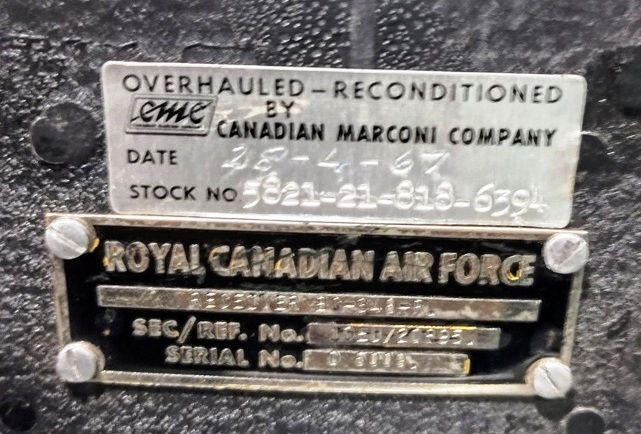
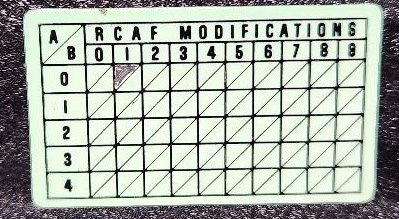
 This unmodified, working receiver, is an ex-Royal Canadian Air Force unit
which was overhauled by the Canadian Marconi Company in 1967. Still evident
on the front panel, is the green RCAF modification sticker. To its left
is an external, home brew power supply/speaker cabinet which was a work
in progress when the photo was taken. Later, the enclosure was painted
black to match the receiver finish.
This unmodified, working receiver, is an ex-Royal Canadian Air Force unit
which was overhauled by the Canadian Marconi Company in 1967. Still evident
on the front panel, is the green RCAF modification sticker. To its left
is an external, home brew power supply/speaker cabinet which was a work
in progress when the photo was taken. Later, the enclosure was painted
black to match the receiver finish. 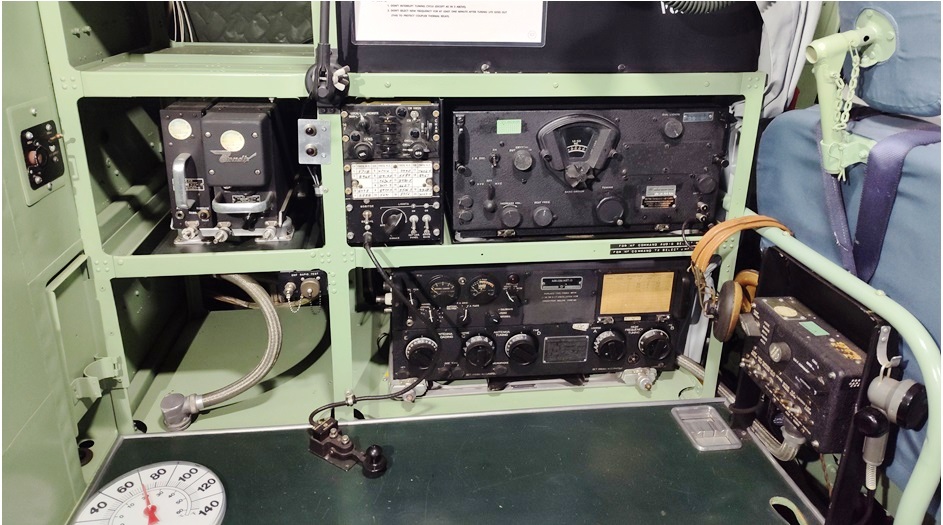
 From
left to right:
From
left to right:
 First built by Marconi in 1942, the thirteen tube CSR5 general coverage
superheterodyne receiver was capable of receiving CW or AM signals in the
80 Khz to 30 MHz bands, less the MF broadast band. The CSR5 receiver served
as a workhorse receiver in the Royal Canadian Navy for nearly as quarter
century. (Donated to HMCS HAIDA).
First built by Marconi in 1942, the thirteen tube CSR5 general coverage
superheterodyne receiver was capable of receiving CW or AM signals in the
80 Khz to 30 MHz bands, less the MF broadast band. The CSR5 receiver served
as a workhorse receiver in the Royal Canadian Navy for nearly as quarter
century. (Donated to HMCS HAIDA).  Made
by Canadian Marconi in 1944, this unit was capable of transmitting on low
wave (375 to 580 kHz) or short wave (1700 to 4200 kHz) depending on the
model type. On receive, it could tune from 300 to 4200 kHz continuously.
Power input was 15 watts on CW, less on MCW and even less on phone. Input
power to the FR12 was 12 volts DC at 6 amps on receive and 13 amps on transmit.
The Royal Canadian Navy (RCN) used this unit for administrative communications
among ships in company during the 1950's and 60's.(Donated to HMCS HAIDA).
Made
by Canadian Marconi in 1944, this unit was capable of transmitting on low
wave (375 to 580 kHz) or short wave (1700 to 4200 kHz) depending on the
model type. On receive, it could tune from 300 to 4200 kHz continuously.
Power input was 15 watts on CW, less on MCW and even less on phone. Input
power to the FR12 was 12 volts DC at 6 amps on receive and 13 amps on transmit.
The Royal Canadian Navy (RCN) used this unit for administrative communications
among ships in company during the 1950's and 60's.(Donated to HMCS HAIDA).