HAIDA'S RADIO EQUIPMENT - 1950's

Equipment specific to the 1950's period is listed in this document. Equipment not described elsewhere in the web page will be featured here.

In the 1949/50 period, destroyers had a TBS set (60 to 80 MHz) for the principal manoeuvring circuit, and the TDQ/RCK (100 to 160 MHz) for the Plot/AIC/CIC circuit. There were other circuits for purposes of air communications.

Lt. Cdr. Frank J. Dunbar reflects on this period. "It wasn't until the advent of UHF that we had the equipment to guard several circuits. HAIDA was the first RCN ship to be fitted with UHF. We were assigned in the fall of 1949 (or possibly 1950) as the token Canadian presence in a USN Task Force that was to conduct an amphibious operation in Labrador. The arrangements for the exercise had been completed with the UK, but when Newfoundland became part of Canada, we had to at least take a token part. It was a 50/50 chance as to which ship was chosen, because only HAIDA and MICMAC were in commission on the East Coast. However, the USN had gone completely to UHF by then, so we were sent down to Norfolk Virginia to have a couple of UHF sets (URT/URR) installed just for the exercise.

I remember that we had next to no air information in the exercise, let alone shore bombardment circuits. But we did get fresh white bread from the freezers of the USN supply ships,  and fresh cod which came from jigging over the ship's side. Which leads me to think that only one TDQ/RCK was left in each ship during the UHF conversion in the early 50's in order to communicate with other users (primarily civilian) who were on VHF only. The major problem was always to get the right crystals, since the TDQ/RCK combo required the use of crystals".

Click on image to enlarge

1953_rad_prob_fig1_s.jpg Figure 1. This was the typical Radio 1 in a Tribal class destroyer in 1953. Since no 1950's layout is available for HAIDA, this one from HMCS Huron will be used for interpretive purposes. (Image courtesy RCN)
1953_rad_prob_fig3_s.jpg Figure 3. illustrates the flow of outgoing radio messages.  (Image courtesy RCN)

RADIO 1  EQUIPMENT MANIFEST - September 1955

TRANSMITTERS
MODEL REF NO. SERIAL NUMBER
PV500 HM2  (HF)  3A/110 376
TDQ (VHF)  CRV 92328 2063
TDZ (UHF)  (See photo in table below)  CG 52342 2093
TED (UHF) 3A/118 364
RECEIVERS
MODEL REF. NO. SERIAL NUMBER
CSR5A (HF) 3A/107/1 871
CSR5A (HF) 3A/107/1 959
CSR5A (HF) 3A/107/1 922
CSR5A (HF) 3A/107/1 931
CSR5A (HF) 3A/107/1 840
RAK5  (LF) 3A/1219 199
RCK (VHF) CZC 46223 2244
RDZ (UHF) See photo in table below n/a 1803
RDZ (UHF)  n/a 1581
FM12 (MF/DF)  AP 5483 8A 176
Antenna Multicoupler T164D 3AU/68 50
TRANSMITTER/ RECEIVER
MODEL REF NO. SERIAL NUMBER
CM11 ( LF/HF) 3A/103 192
FR12 (HF)  3A/309 NIL
TBS 7 (VHF) CG 52093 Transmitter
CG 46068 Receiver
733 or 449 (?)
449 or 773 (?)
PORTABLE SETS 
MODEL REF NO. SERIAL NUMBER
CRT-1/CPRC-26  nil 12574
CRT-1/CPRC-26  nil 12571
CRT-1/CPRC-26  nil 13016
REMOTE CONTROL EQUIPMENT
MODEL REF WHERE FITTED
QM11 (unidentified). Might be
for the CM11.
3A/60 Three in Ops Room
Two on Bridge
For TBS 7  CRV2315  Two in Radio 1
Two in Ops Room
Two on Bridge
For TDQ/RCK combo CCT 23211A Two in Ops Room
Two on Bridge
Speaker Amplifier Units 
for TDQ/RCK combo
CMX 49620 Two on Bridge
Two in Ops Room
For TDZ/RDZ combo CCT23211A One in Bridge
CQC (unidentified) 23496 One in Ops Room
RADIO TELETYPE EQUIPMENT
MODEL REF NO. SERIAL NUMBER
FSK Frequency Shift Keyer XFK169 ?
FSC Frequency Shift Conv. Type 107   RCN 23AU/37 ?
SFO Regenerator (see photo in table) ? 173
TD Distributor 59354 ?
Teleprinter Model 15 122943 ?
Reperforator Model 14 72797 ?

RADIO 2  EQUIPMENT MANIFEST - September 1955

MODEL REF NO. SERIAL NUMBER
CM11 #1 3A/103 368
CM11 #2 3A/103 381

RADIO 3  EQUIPMENT MANIFEST - September 1955

MODEL REF NO. SERIAL NUMBER
TBS 7 CG52093 ?

RADIO 4  EQUIPMENT MANIFEST - September 1955

MODEL REF NO. SERIAL NUMBER
SHF DF Unit AN/UPD-501 ?
HF receiver - Hammarlund SP-600 ?

MISCELLANEOUS EQUIPMENT  - September 1955

MODEL REF NO. SERIAL NUMBER
SRE  RCA Model 456 (need photo) ?
Two Whip Antennas 35 foot  3BA/16 3S1/347  n/a
Two TDQ/RCK Dipoles CLS 66059 n/a
Two TDZ/RDZ Dipoles General Electric n/a
Manufacturer codes for equipment made in the USA:

CAY - Westinghouse
CCT - Stromberg-Carlson
CFT - Federal
CME - RME
CNA - National
CND - Andrea
CPN - Panoramic
CRV - RCA
CWQ - Wells Gardner
CZC - Scott 

FEATURED EQUIPMENT
 
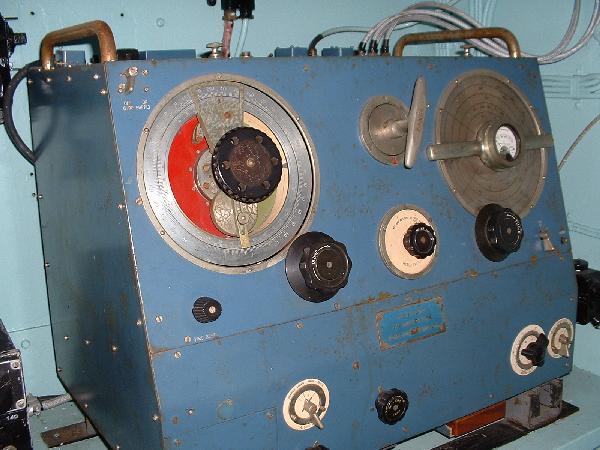
rrp/tdz_s.jpg TDZ - UHF Shipboard Transmitter. Circa 1944. Freq range  225 to 400 MHz; 30 watts output; Modes - MCW and AM. Click on photo for more photos and info.  (Photo courtesy Nick England's Navy Radio site) 
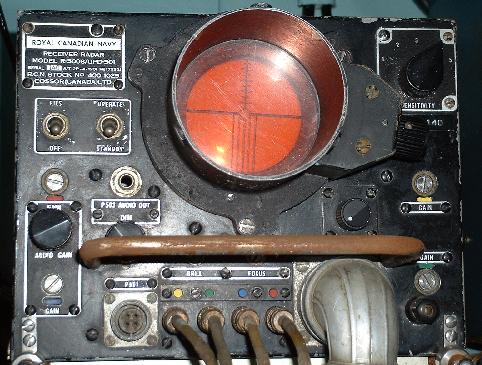
rdz_s.jpg RDZ - UHF Shipboard Receiver. Circa 1944. Freq range - 225 to 400 MHz. Can be used with manual tuning or 10-channel autotune. MCW or AM only.  Weight - 150 pounds.Click on photo for more info. (Photo courtesy Nick England's Navy Radio site) 
TE-236 LF Receiver. 15 KHz to 600 KHz.  This is identical to the RAK receiver except that it lacks the audio filter and monitoring meter. Made by RCA Victor, Montreal. (Photo by Jerry Proc)
sfo_regenerator_s.jpg SFO - Teletype Regenerator. The SFO is capable of accepting teletype signals in audio (on-off) form or in direct current form (polar and neutral) and having up to 45% bias distortion. When regenerated, the output signal will have less than 5% distortion. Made by Technical Material Corp. The unit in the photo has its front panel door in the down position. (Photo courtesy TMC Commercial Manuals web site)

SPECS
* Accepts 60, 75 and 100 wpm teletype signals.
* Input keying - 500 to 3 KHz tone, 30 ma polar, 60 ma neutral, simplex or diplex 
* Power input: 105 to 125 VAC, 50 to 60 Hz;  85 watts.

Many equipment types shown in HAIDA's Radio 1 and 2 documents  and described fully, were also fitted in September 1955. These are not described here in the interest of simplicity. Only links to the photos are provided. 
Portable Radio
ws58_in_use.jpg
An Athabaskan crew member uses the WS-58 portable set. Uses included short term communication between ships for such jobs as jack-stay transfers, underway fuelling and practice shoots. (Crowsnest photo, December 1950)
ws58.jpg
The WS-58 Mk1/T set was the Navy's portable radio until replaced by the CPRC-26 set around the mid 50's. It was a man pack transceiver developed in 1943 for use by the Army.  Frequency range 6-9 MHz. RF output 0.3 watts. MO control. R/T only. Range up to 5 miles. (Photo courtesy Wireless for the Warrior)

MISCELLANEOUS INFORMATION

A report on HAIDA's radios dated October 1955, indicates the following deficiencies.
1) The ship has insufficient VHF/UHF channels for use in large scale exercises.  Any equipment failures only worsen the problem.
2) The antenna multicoupler (model not identified) is considered inefficient and the lack of an aerial patch board impacts reception capability.
3) Radio 1 and Radio 4 are heating excessively due to an inefficient ventilation system. This is believed to be inducing equipment failures. During summer months, temperatures of over 90F have been recorded with a consequent hardship on operators.
4) During major exercises, a 24 hour watch is maintained in the Crypto Office. At times it is necessary to have two operators closed up. Due to cramped quarters and poor ventilation, this has proved to be an unsatisfactory arrangement.
5) The intercom fitted from the bridge to the flag deck is inefficient due to the exposed position of the intercom boxes.
6) Light leakage from the two 10 inch signal projectors prevents the "Nancy" (IR) gear from being used.
This is just a small sampling of the pesky problems that were experienced aboard ship.
 
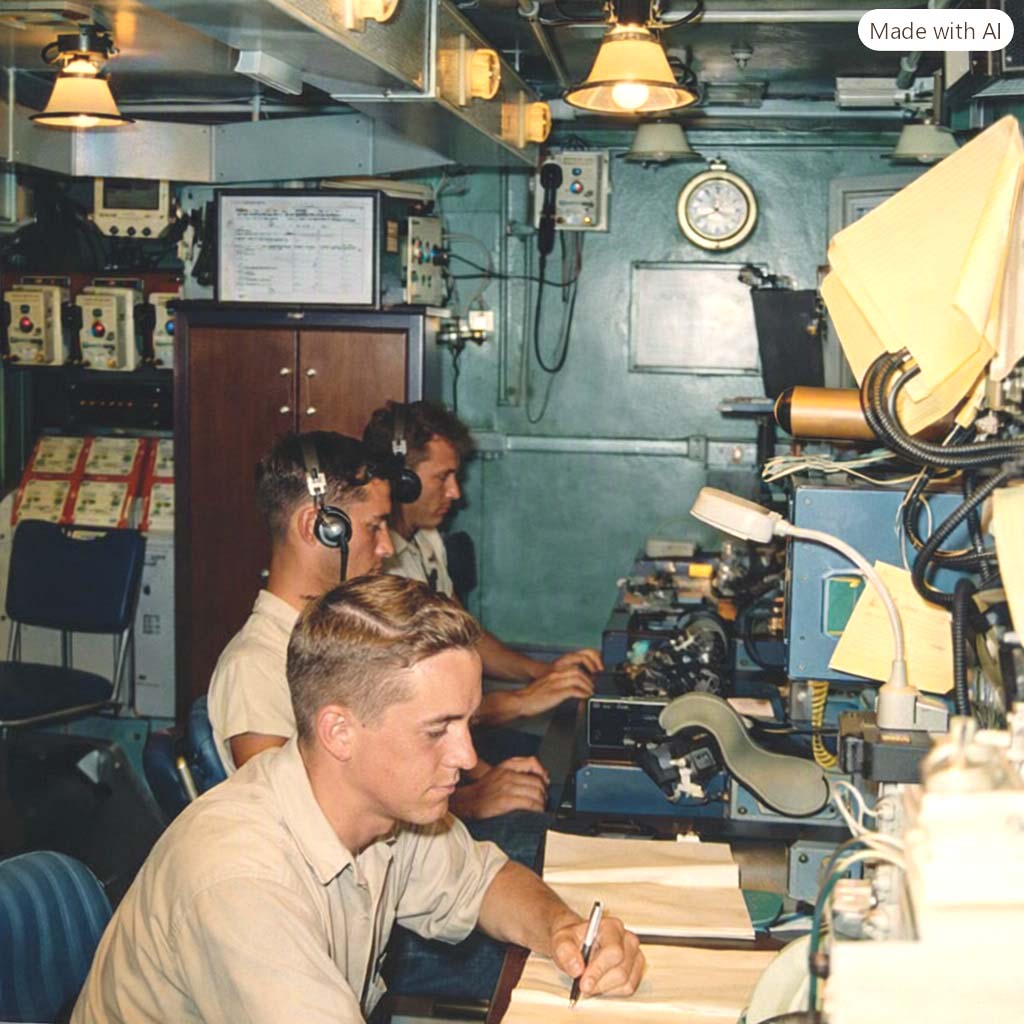
Hardworking Radiomen on watch. This scene was typical in Radio 1 in 1956. (Photo courtesy HMCS HAIDA archives)

In this photo,  the walls of the Message Centre have not yet been erected. The vent trunking appears to be all metal and  lacks the wood veneer that is visible today. The metal desks that we see today are not present. At each operating position is a goose neck lamp and a Remington typewriter. Other than officially sanctioned photographs, it was against regulations to photograph any area of the ship. If it wasn't for these clandestine pictures, scenes such as this would be lost forever. 

1956: Judging by the smiles on their faces, these Radiomen must be thinking about their next shore leave. Seated from left to right are Jim Benson as ABRM - now deceased; Neil McAskill as PO2, now retired as CPO2. Jack Wells as ABRM, retired as LCdr and now deceased. (Photo courtesy HMCS HAIDA archives)

In 1955, HAIDA carried a complete complement of eight CV's and eight CR's along with two CS ratings.

LF Reception

Ronald Yaschuk explains the purpose of the Model TE-236 LF receiver fitted on the starboard bulkhead in one of the photos above. "The LF setup in ship's at sea was designed to copy the submarine broadcast, either at normal speed or a high-speed burst. When the submarine was submerged during an exercise, it could not copy the broadcast since LF does not penetrate seawater. Hence. the Commander of the Task Force, Task Group etc., designated one ship as SUBMARINE GUARD. This was also laid out in the OPORDER Exercise Book. If your ship was tasked with this duty,  you copied the submarine broadcast as well as the fleet broadcast. It was not a pleasant job as I recall, but someone had to do it.

When the submarine surfaced, the Guard ship would rebroadast  the the information to the submarine. Low speed broadcasts were fairly reliable but the high speed burst could be obliterated or garbled by static or interference  If both the sub and the ship missed the broadcast, you waited until the next designated broadcast period.  If anything critical was missed that left the ship and the sub scrambling to obtain the the required information for the next phase of the EXERCISE.  In addition, PL (plain language) sent to the sub had to be buttoned up (encrypted) and sent by CW which took a considerable amount of time. Meanwhile, during all of this, you had the C.O, OPSO an COMO hanging over your shoulder making things even more difficult".

Transmitter Key Board

The transmitter key board  held only the keys that belonged to the radio transmitters. Any radioman who had to perform maintenance on an antenna would take the key off the board, then use it to disable the transmitter thus making it safe. The man aloft keyboard (for radars) was held in the Wardroom and was controlled by the Officer Of the Day (OOD). A sign in/out log would  tell him who held the keys. By 1962, the both radar and radio transmitter keys were stored on the Man Aloft Board which was mounted in the Message Centre aboard HAIDA.

The transmitter key board or man aloft board in many ships was usually made by one the shipwrights in exchange for a favour like a few tots of rum. It was usually made from mahogany or any other wood which was handy. Key identifiers and numbers were etched on little brass plates and the inside of  the key board was lined with a green felt cloth.  Key boards were also made of aluminum with a lockable hasp. They did not look pretty but served the purpose.


Credits and References:

1) Library and Archives Canada File 7400 DDE_215 provided by Robert Langille <ewcs(at)ewcs.ca>
2) SFO photo - Courtesy TMC Commercial Manuals web page
    http://www.virhistory.com/tmc/tmc_pages/tmc_commercial_manual_page.htm
3) RDZ photo:  http://www.navy-radio.com/rcvr-ww2.htm
4) TDZ photo: http://www.navy-radio.com/xmtr-ww2.htm
5) Lt Cdr Frank J. Dunbar


Back to Table of Contents


Feb 5/11