RIVER CLASS FRIGATES - Radio Fit
GENERAL
Initially called twin-screw corvettes, frigates were designed
for the RN by William Reed. The design of the Frigate was intended to alleviate
the shortcomings of the Corvette as an ocean escort. Frigates built
for the Royal Navy were named after rivers hence they acquired the name
River Class. Vessels built for the RCN were named after towns and cities.
There were two building programs with HMCS Waskesiu the first to commission
in June 1943. A total of sixty were built. There were 10 built for the
Royal Navy and two of those found their way into the USN.
After VE day some ships were taken in hand for tropicalization to be
sent to the Pacific but only a few had completed the process by VJ day.
One of the items on the work order provided for an air conditioner in the
radio office. It was installed for the benefit of the equipment and not
the hands.
After WWII, eleven of them were stripped and sunk as breakwaters for
British Columbia logging firms. The remainder saw service as training ships
and between 1953 and 1958, twenty one of them were modified to emerge as
the Prestonian class frigates.
There is an interesting point to note about the River Class pendants.
The RCN changed the system of numbers and type designators for the fleet
effective Jan 10, 1949 [4] . Swansea, while still in her River class configuration,
is shown wearing pendant 306 in a photo dated July 1953 and well ahead
of her conversion to a Prestonian in 1957. A quick study of the photos
in the book "Frigates in the RCN" by Ken Macpherson, reveals that
La Hulloise was wearing pendant 305 by July 1950 and Antigonish was sporting
301 in 1951, both as River class configurations and all three wearing the
Maple Leaf on the funnel. It is theorized that all of the River class ships
which were still in service after 1949 quickly received new pendants and
in three verifiable cases, far ahead of their conversion to Prestonian
class.
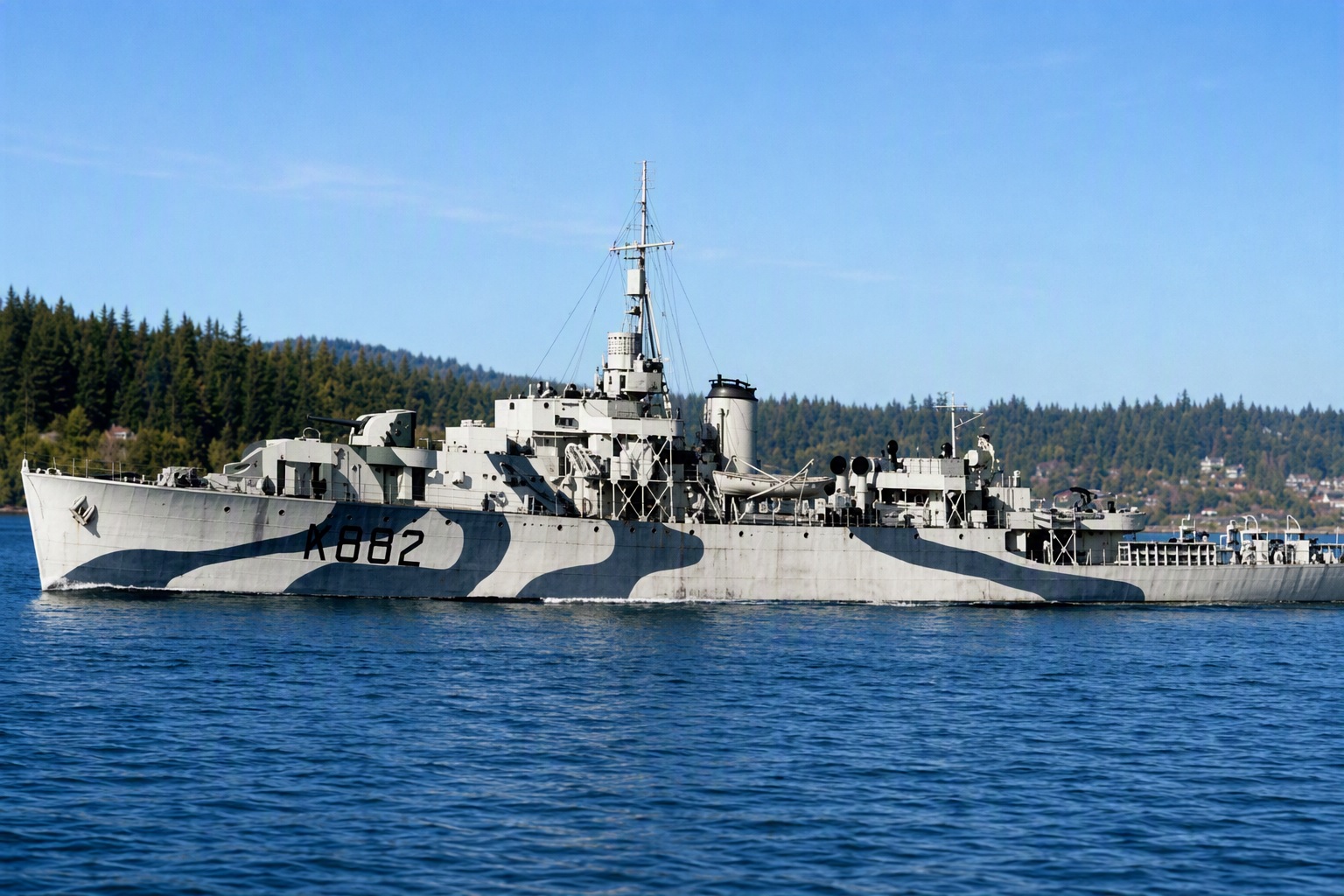 |
| HMCS Strathadam is being used to represent the entire River class.
Here she is seen on the west coast on October 27, 1944. (Photo courtesy
Frigates of the Canadian Navy. Colourized by CHATgpt. ) |
| VITAL STATISTICS |
|
| Length: 301.6 feet |
Breadth: 36.7 feet |
| Draught: 12'9" mean |
Displacement: 2216 tons |
Speed: 19 knots
Endurance: 7200 miles @12 knots |
Crew: 8 officers and 133 men (1943) |
Armament: 1 twin 4 in gun; 1 x 12
pdr; 4 twin 20 mm guns in paired
mounts; Hedgehog; 4 depth charge throwers;
150-200 depth charges. (1942-43 program) |
Building Programs
1942-43: 33 ships for the RCN.
1943-44: 27 ships for the RCN.
10 built for the Royal Navy |
RADIO OFFICE
According to Alan Riley, a WWII telegraphist, River class Frigates
were typically fitted with the following equipment:
| TYPE |
QTY |
| CM11 transmitter/receiver 375 kHz to 13.5 MHz
; 100 watts CW |
2 |
| FR12 transmitter/receiver LF/HF (2-4 MHz)
15 watts CW |
1 |
HF/DF - FH-3 with
CSR5 receiver. (wartime confiiguration) . By war's end, FH3
s and FH4's would be replaced with the American DAU direction finder. |
1 * |
| HT11 HF AM radiotelephone |
1 * |
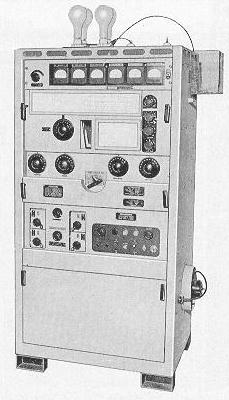
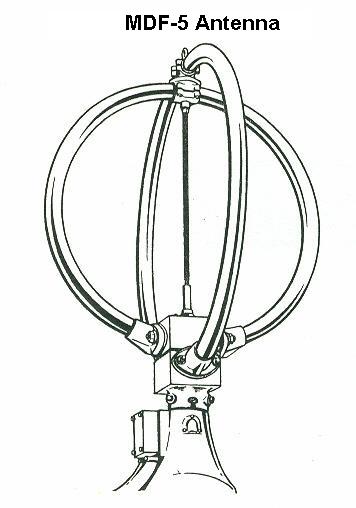
| MF/DF - Canadian Marconi MDF-5 |
1 |
| PV500 HM transmitter 3-18 MHz ; 500 watts |
1 |
| TBS VHF transmitter/ receiver (60 to 80 MHz;
50 watts) |
1 |
An asterisk (*) means that only the Group Leader would have this gear
installed..
 |
Frigate starboard side view showing main wire
aerials. The four main LF antenna are really only two because each pair
is joined together at the feed point. Click to enlarge. (Image courtesy
Frigates of the RCN). |
 |
1941: In this undated configuration ,
the W/T office and the DF office have been combined and located to the
Forecastle deck. Its position is shown relative to the bow. Click on image
to enlarge. (Maritime.org) |
 |
1941:This is an enlargement of the
combined W/T and DF compartment. Click on image to enlarge. (Courtesy
Maritime.org) |
 |
Undated - In this configuration, the DF
Office was located on the Signal deck and the W/T office was most ;likely
on the Forecastle deck.. Click to enlarge. (Image courtesy Frigates
of the RCN) |
Radio aerial inventory from the main plan, starboard view:
2 LF Aerials - Each LF aerial consists of two spans joined to a common
feed.
1 HF Aerial
1 Sound Reproducing Equipment Antenna
1 FR 12 aerial for Canadian Marconi FR12 LF/HF transmitter/receiver
1 Loran (LRN) wire aerial
1 DF loop for MDF-5
1 Sense aerial for MDF-5
 |
| This is the main radio office aboard HMCS Strathadam. |
From the above photo, its very easy to identify the equipment
line up (L-R): CSR5 receiver, MSL-5 receiver, another CSR-5 and a
portion of an FR12, all made by Canadian Marconi. Pat Kelly, who served
in a River class frigate remembers two radio rooms - one being the main
radio office and another down below for use in an emergency (Radio 2).
 |
| Radio room of HMCS PRINCE RUPERT (K324). This was taken on October
22nd, 1943, the day after she arrived in Halifax from her builders Yarrows
Ltd., Esquimalt B.C. Click on image to enlarge.
Left side of photo: PV500H transmitter
Right side of photo from left to right: Two SMR3 receivers and a FR12
and just a sliver of an MSL5 can be seen at the right. (Public
Archives Canada Photo HS-0262-1 submitted by Spud Roscoe. Colourized by
Copilot) |
RADIONAVIGATION
According to Bowditch -The American Practical Navigator, LORAN was derived
from the words LOng RAnge Navigation. If those three
words are abbreviated, it becomes LRN, the exact term on the Frigate drawing.
Prior to being called LORAN it was known as LRN [1] as well but meaning
"Loomis Radio Navigation" in honour of F.W. Loomis [2], Associate Director
of MIT's Radiation Laboratory who had previously been the Head of the Physics
Department at the University Illinois.
The River class plans shown above are applicable to seven ships of the
1942/43 River class program. HMCS Waskesiu was a part of this group and
commissioned in June 1943. That means that LORAN was being fitted in RCN
ships by early/mid 1943.
For detailed information on Loran 'A',
select
this link.
RADAR
On-build, Type 271 (10 cm) was the standard radar fit on the River class
and the antenna was mounted at the base of the foremast. Technical specifications
on the 271 radar can be found here.
A study of River class photos reveals a radar modernization which appears
to have started after 1945. The 271 radar was removed from the foremast
base and the USN Type SU
radar was fitted on the foremast. In the case of HMCS Charlottetown, this
occurred in 1946. The position of the SU radar was not always consistent
from ship to ship. Sometimes its positioning caused the HFDF antenna to
be relocated to the mainmast peak.
The following River class frigates are known to have received SU radar
modernizations and in some cases, far ahead of their conversion to Prestonian
class ships. These ships are:
FotRCN= Frigates of the Royal Canadian Navy by Ken Macpherson.
ANTIGONISH
(pg. 58, FotRCN, with 301 painted on side in 1951)
CHARLOTTETOWN K244 (pg. 20 FotRCN, in 1946)
GROU K518
(pg. 25 FotRCN, possibly in February 1945)
LA HULLOISE
(pg. 30, FotRCN, in 1950 with 305 painted on)
OUTREMONT K322
(pg. 40 FotRCN, in 1945)
ST. CATHARINES
(pg 104, FotRCN, in 1945)
STORMONT K327
(pg. 47 FotRCN, in 1945 waiting for disposal)
SWANSEA
(pg. 49 FotRCN, in 1953, with 306 painted on side)
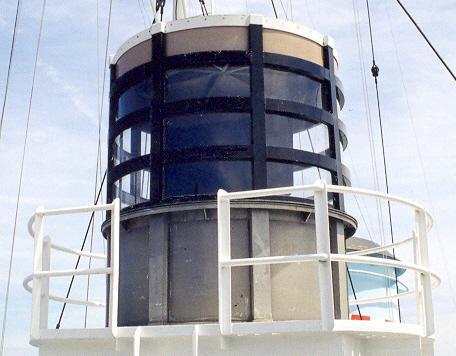 |
| Perspex enclosure for the 271 radar antenna. This is the recreated
enclosure found on HMCS Sackville. (Photo by Jerry Proc) |
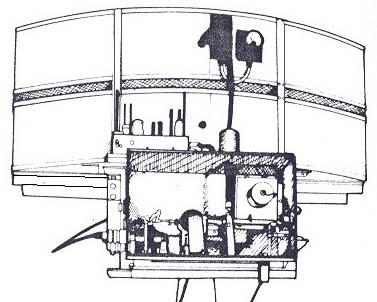 |
| This is a rare image of the 271 radar antenna. The double cheesecake
construction means separate transmitting and receiving antennas. Shown
is the backside of the antenna (Graphic source unknown) |
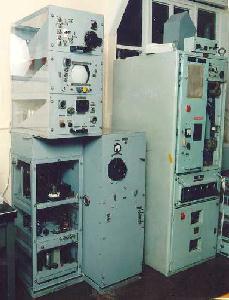 |
| 271 radar set. (Photo courtesy of HMS Collingwood, Fareham
England) |
ASDIC
128 Set (circa 1937)
Frigates and Bangors were equipped with the 128 set [3]. This was the
retractable dome version of the British 127 set and was superior in performance
to the 123A since it relied on a gyro compass instead of a magnetic compass
for bearing indication. Priority was given for the fitting of the 128 set
in Bangors because it was originally intended that their primary role was
to be minesweeping, a task that required accurate navigation to mark swept
channels. Corvettes, which were supposed to be jack-of-all trades -- such
as escort, minesweeper, and patrol craft, would have to suffice with the
less accurate 123 set which employed a magnetic compass.
In February of 1943, the British Admiralty announced that the 128 set
was being superseded by 128A. Type 128A had a training mechanism that was
manipulated electrically rather than mechanically and was kept on target
automatically by the ships gyro compass. The RCN quickly approved the same
change for its own Bangors, however, it had to wait for a British policy
statement before work could start. There were nineteen versions of the
128 set produced during World War 2.
The data in the tables below was extracted from BR 299, a Royal Navy
publication dated 1947. Photos and specs for some of this equipment can
be found in this document
Any numeric suffixes which appear for American made equipment, denote the
procurement contract number. A TBL-4 is identical to a TBL-12 but
was made on perhaps a under a different contract number or even a different
contractor.
For some unknown reason, BR299 only shows radio fits for six River class
frigates.
| ANTIGONISH (as K661, 1944
to 1946) |
|
|
| Main Office |
PV500 HM - HF transmitter; 3 to 18 MHz
, CW/MCW, 500 watts.
2 x FR12 - Low power transmitter/receiver. CW/MCW/Phone, 15 watts on
CW.
CM11 - LF/HF transmitter/receiver. CW/MCW/Phone, 100 watts on CW.
MSL5 - LF receiver, 15 KHz to 1550 or 1775 KHz.
2 x CSR5 - LF/MF/HF receiver, 80 KHz to 30 MHz excluding broadcast
band.
FM12 - MFDF outfit, 40 to 1000 KHz..
FH3 - HFDF outfit 670 KHz to 20 MHz. Using CSR5 as the intercept receiver.
GR - Wavemeter outfit. GR is Royal Navy version of the RAF Crystal
Monitor 2. |
| Aerial Outfit |
None indicated |
| Miscellaneous |
None indicated |
| BEACON HILL (as K407, 1944
to 1954) |
|
|
| Main Office |
PV500 HM - HF transmitter; 3 to 18 MHz , CW/MCW,
500 watts.
PV500 LM - LF transmitter 100 to 500 KHz, CW/MCW, 500 watts.
FR12 - Low power transmitter/receiver. CW/MCW/Phone, 15 watts on CW.
HT11 - HF radiotelephone. Frequency range : Receive - 550 KHz
to 1700 KHz and 2000 to 3000 kHz. Transmit - 2000 to 3000 kHz. 12
watts.
TBS4 - VHF radiotelephone. 60 to 80 MHz ; 50 watts
86M - Brirish version of the American SCR-522 radiotelephone.
MSL5 - LF receiver, 15 KHz to 1550 or 1775 KHz.
2 x CSR5 - LF/MF/HF receiver. 80 KHz to 30 MHz. No broadcast
band.
MDF5 - MFDF outfit ;265 to 670 KHz.
FH3/CSR5 - HFDF outfit 670 KHz to 20 MHz. Using CSR5 as the intercept
receiver. |
| Aerial Outfit |
APH - Aerial outfit for 86M set
APU - Aerial outfit for TBS transmitter |
| Miscellaneous |
TBY - Portable radio. 28 to 80 MHz range. 0.5
watts out.
DAS1 - Loran 'A' receiver.
0F - Deck insulator for DAS1 Loran receiver |
| LA HULLOISE (as K668. from
1944 to 1953) |
|
|
| Main Office |
PV500HM - HF transmitter; 3 to 18 MHz , CW/MCW,
500 watts.
PV500 LM - LF transmitter 100 to 500 KHz, CW/MCW, 500 watts.
FR12 - Low power transmitter/receiver. CW/MCW/Phone, 15 watts
on CW.
HT11 - HF radiotelephone. Frequency range : Receive - 550 KHz
to 1700 KHz and 2000 to 3000 kHz. Transmit - 2000 to 3000 kHz. 12 watts
TBS - Low power transmitter/receiver. CW/MCW/Phone, 15 watts on CW.
MSL5 - LF receiver, 15 KHz to 1550 or 1775 KHz.
2 x CSR5 -LF/MF/HF receiver. 80 KHz to 30 MHz .No broadcast band.
MDF5 - MFDF outfit; 265 to 670 KHz.
FH4/CSR4 - DFDF Outfit 1 to 25 MHz (See note 5) |
| Aerial Outfit |
APU - Aerial outfit for TBS transmitter |
| Miscellaneous |
None indicated |
| NEW WATERFORD ( as K321.
from 1944 to 1953) |
|
|
| Main Office |
PV500HM - HF transmitter; 3 to 18 MHz , CW/MCW,
500 watts.
PV500LM - LF transmitter 100 to 500 KHz, CW/MCW, 500 watts.
FR12 - Low power transmitter/receiver. CW/MCW/Phone, 15 watts
on CW.
HT11- HF radiotelephone. Frequency range : Receive - 550 KHz
to 1700 KHz and 2000 to 3000 kHz. Transmit - 2000 to 3000 kHz.
TCS10 - Radio set. 1500 – 12,000 kHz range in 3 bands.
TBS - VHF radiotelephone. 60 to 80MHz.
86M - Brirish version of the American SCR-522 radiotelephone.
MSL5 - LF receiver, 15 KHz to 1550 or 1775 KHz.
2 x CSR5 - LF/MF/HF receiver. 80 KHz to 30 MHz . No broadcast
band.
FH3/CSR5 - HFDF outfit 670 KHz to 20 MHz. Using CSR5 as the intercept
receiver.
GR - Wavemeter outfit. GR is Royal Navy version of the RAF Crystal
Monitor 2. |
| Aerial Outfit |
APH - Aerial outfit for 86M set.
AHD - Unable to identify |
| Miscellaneous |
2 x Type 67 - Portable radio. WS67 (AP
W3217) is the Royal Navy version of the British Army WS27 set
TBY8 - Portable radio. 28 to 80 MHz range. 0.5 watts out. |
| ST, STEPHEN (as K454. 1944
to 1950) |
|
|
| Main Office |
PV500HM - HF transmitter; 3 to 18 MHz , CW/MCW,
500 watts.
PV500LM - LF transmitter 100 to 500 KHz, CW/MCW, 500 watts.
2 x CM11 - LF/HF transmitter/receiver. CW/MCW/Phone,CW/MCW/Phone,
100 watts on CW.
HT11 - HF radiotelephone. Frequency range : Receive - 550 KHz
to 1700 KHz and 2000 to 3000 kHz. Transmit - 2000 to 3000 kHz.
TBS4 - VHF radiotelephone. 60 to 80MHz.
MDF5 - MFDF outfit ;265 to 670 KHz.
TDQ - A four channel VHF transmitter, 100 to 156 MHz , MCW/Phone, 45
watts
MSL5 - LF receiver, 15 KHz to 1550 or 1775 KHz.
2 x CSR5 - LF/MF/HF receiver. 80 KHz to 30 MHz. No broadcast band.
RCK - A four channel VHF receiver, 100 to 156 MHz. Companion receiver
for TDQ
DAU/CSR5 - DF outfit, 1.5 to 30 MHz, with CSR5 as the intercept receiver. |
| Aerial Outfit |
APU - Aerial outfit for TBS transmitter. |
| Miscellaneous |
None indicated. |
| SWANSEA (as K328. 1943 to
1953) |
|
|
| Main Office |
PV500HM - HF transmitter; 3 to 18 MHz , CW/MCW,
500 watts.
PV500LM - LF transmitter 100 to 500 KHz, CW/MCW, 500 watts.
2 x CM11 - LF/HF transmitter/receiver. CW/MCW/Phone,CW/MCW/Phone, 100
watts on CW.
HT11 - HF radiotelephone. Frequency range : Receive - 550 KHz
to 1700 KHz and 2000 to 3000 kHz. Transmit - 2000 to 3000 kHz.
TBS4 - VHF radiotelephone. 60 to 80MHz,
MDF5 - MFDF outfit ;265 to 670 KHz.
TDQ - A four channel VHF transmitter, 100 to 156 MHz , MCW/Phone,
45 watts
2 x CSR5 - LF/MF/HF receiver. 80 KHz to 30 MHz No broadcast band.
MSL5 - LF receiver, 15 KHz to 1550 or 1775 KHz.
RCK - A four channel VHF receiver, 100 to 156 MHz. Companion receiver
for TDQ.
DAU/CSR5 - DF outfit, 1.5 to 30 MHz, with CSR5 as the intercept receiver. |
| Aerial Outfit |
APU - Aerial outfit for TBS transmitter |
| Miscellaneous |
None indicated. |
DISPOSAL
* After the end of WWII, the River class frigates were destined to various
fates. Many were scrapped or sold to civilian interests. Select
this link to see the details.
* Naval historian Spud Roscoe complled a list of which River class frigates
were saved for conversion to the Prestonian class.
THE 21 PRESTONIAN CLASS CLASS FRIGATES ( Circa 1962)
Name, call sign, pendant number and years in naval service (the year
scrapped in brackets if different than when naval service terminated).
4th Escort Squadron (West Coast)
ANTIGONISH CGJC 301 1957-1966
BEACON HILL CGJJ 303 1957-1967
JONQUIERE CZJZ 318
1954-1966
NEW GLASGOW CYXV 315 1954-1967
STE THERESE CGTC 309 1955-1967
STETTLER
CGLH 311 1954-1966
SUSSEXVALE CZFM 313 1954-1966
7th Escort Squadron (East Coast)
FORT ERIE
CGWY 312 1954-1965
INCH ARRAN
CGLU 308 1954-1965 (1970)
LANARK
CGRE 321 1956-1965
NEW WATERFORD CYTQ 304 1958-1966
OUTREMONT
CGZV 310 1954-1965
VICTORIAVILLE CGVF 320 1954-1966
(1974)
9th Escort Squadron (East Coast)
CAP DE LA MADELIENE CZJM 317 1954-1965
LA HULLOISE
CGWV 305 1957-1965
BUCKINGHAM
CGZB 314 1954-1965
LAUZON
CYVH 322 1953-1963
SWANSEA
CYRF 306 1957-1966
Transferred to Norway 1955
PENETANG CYTL 316 1954
PRESTONIAN CGXC 307 1953
TORONTO CZGL 319 1953
FOOTNOTES:
[1] According to an article published in MIT's "THE TECH" newspaper,
Dec 5, 1967.
[2] In 1940, Loomis conceived the idea of a precision long-range radio
navigation system. The LORAN team, working from MIT's Radiation Laboratory
was led by Dr. John A. Pierce of Bell Labs and by 1942, the first Loran
station was operating from the American East Coast on 1.95
MHz.
[3] In "Seek and Strike" by Willem Hackman, he shows Frigates as using
the 127 type.
[4] Battle Ensign Flying, Barry Gough, page 155
[5] The receiver notation of "CSR4" might be a typo. Perhaps it should
read as "CSR5 "
Contributors and Credits:
1) Frigates of the Royal Canadian Navy 1943- 1974 by Ken
Macpherson. Vanwell Publishing, St. Catharines Ont. 1989
2) Ships of Canada's Naval Forces (1910-1993) by Ken
Macpherson and John Burgess.
3) Alan Riley, ex-RCN. Toronto
4) Spud Roscoe <spudroscoe(at)eastlink.ca>
4) Don Wagner <navwags(at)earthlink.net>
5) Bowditch -The American Practical Navigator
http://www.irbs.com/bowditch/
6) MIT Archives http://www-tech.mit.edu/archives/VOL_087/TECH_V087_S0526_P005.pdf
7) Alexander (Sandy) McClearn <smcclearn(at)ns.sympatico.ca>
8) Pat Kelly <pnkelly(at)shaw.ca>
9) Clive Kidd, Collingwood Heritage Museum <cjckidd(at)waitrose.com>
10) BR299 dated 1947, Royal Navy.
11) Canadian Warship Names by David Freeman. Vanwell
Publishing , St. Catharines , Ont.2000
12) MIchael Whitby <Michael whitby (at)forces.gc.ca>
13) Ship's Deck Plans River) https://maritime.org/doc/plans/
Back to Table of Contents
Aug 23/26